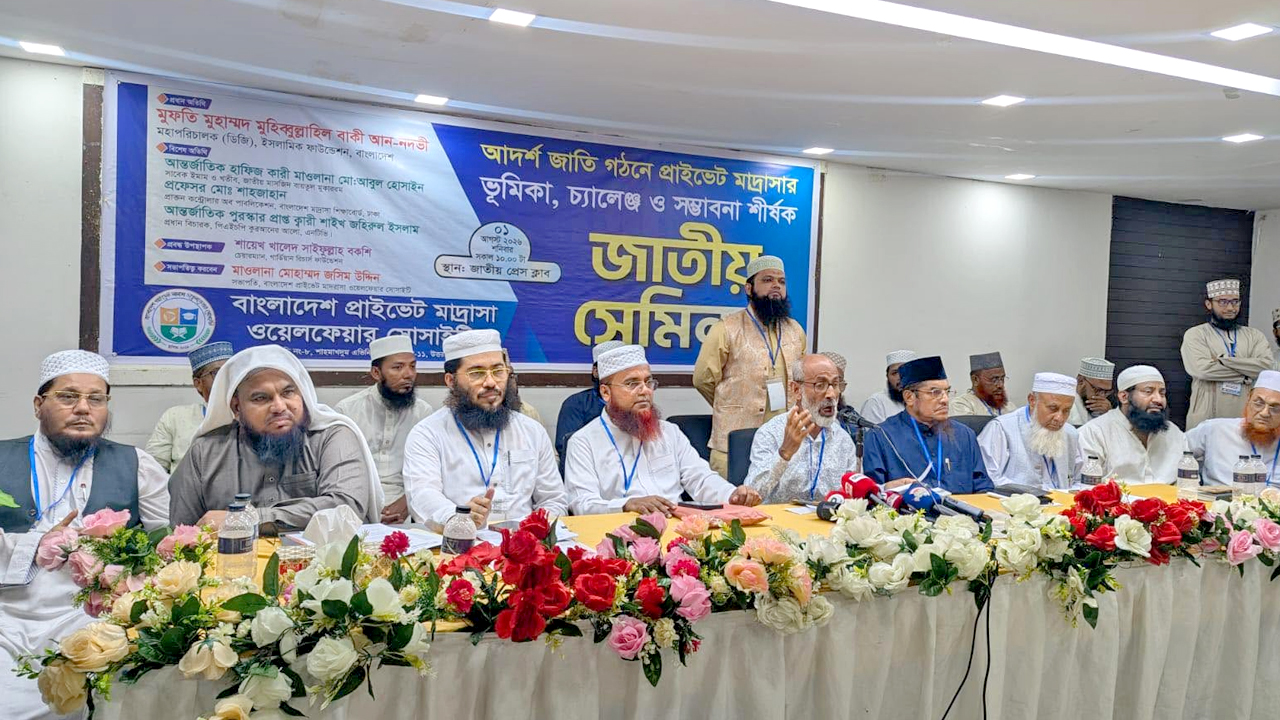
Staff Reporter : The Bangladesh Private Madrasa Welfare Society has placed an 18-point demand before the government, calling for the registration of all categories of private madrasas, the formulation of a unified policy, improvements in educational standards, stronger child protection measures, and greater accountability across the sector.
Speaking at a press conference held at the National Press Club on Saturday (August 1), the organization`s leaders said the event was not intended to oppose any individual, institution, or media outlet. Rather, its objective was to present the Society`s position on safeguarding the dignity, security, good governance, accountability, and educational quality of Alia, Qawmi, Hifz, Nurani, and other independent private madrasas across Bangladesh.
The speakers said that private madrasas in Bangladesh have long played a significant role in providing education based on the Qur`an and Sunnah, promoting moral character, patriotism, and humanitarian values. They noted that graduates of these institutions have demonstrated competence and integrity in Islamic education, higher education, public administration, business, research, and various professional fields both at home and abroad. They also highlighted the achievements of Bangladeshi madrasa students in international Qur`an memorization competitions, Arabic language studies, and Islamic research, which, they said, have enhanced the country`s reputation globally.
The press conference further stated that whenever allegations of criminal misconduct are made against an individual or institution, they should be addressed through impartial investigations, transparent judicial processes, and due legal procedures. However, the organization expressed concern that in recent times, isolated incidents, the revival of previously resolved matters, and the circulation of AI-generated videos on social media have led to the entire madrasa education system being questioned even before investigations are completed. According to the speakers, this has caused innocent teachers, students, parents, and educational institutions to suffer social and reputational harm.
The organization`s leaders argued that just as isolated incidents cannot be used to judge the entire school, college, or university system, it is equally unfair to assess the country`s entire private madrasa sector based on allegations involving a single institution.
They said the Bangladesh Private Madrasa Welfare Society was established to promote unity, coordination, educational excellence, child protection, accountability, legal support, research, and to create a responsible national platform for private madrasas. They emphasized that the organization is not intended to create division but rather to foster cooperation, reform, development, and collective efforts in the national interest.
The speakers also stressed that a safe, child-friendly, accountable, and internationally competitive madrasa education system can be achieved through coordinated efforts by the government, media, civil society, parents, law enforcement agencies, and private madrasas.
The Society`s 18-Point Charter of Demands
- Register all private madrasas under the Bangladesh Madrasa Education Board following proper verification and evaluation.
- Issue EIIN (Educational Institute Identification Number) to all private madrasas without delay and eliminate unnecessary bureaucratic obstacles in the process.
- Grant academic recognition and permission, subject to specified conditions, for private madrasas operating in rented buildings.
- Allow educational institutions to issue certificates in the name of their respective institutions.
- Ensure that students of private madrasas are eligible for both government and non-government scholarship and stipend programmes.
- Formulate and publish a transparent and unified national policy for Alia, Qawmi, Nurani, Hifz, and other private madrasas.
- Facilitate institutional support and timely distribution of textbooks through local education offices.
- Provide teacher training for private madrasa teachers through the appropriate authorities on ethics, child psychology, modern educational management, legal awareness, and professional development.
- Ensure representation of private madrasa stakeholders within the Bangladesh Madrasa Education Board.
- Provide information technology support, computers, and educational equipment through the Ministry of Education.
- Take effective measures to prevent harassment of private madrasas by various agencies and politically motivated groups.
- Adopt a coordinated development policy for Alia, Nurani, Hifz, and other categories of private madrasas.
- No institution or its students should suffer punitive consequences based solely on allegations against an individual without a fair and impartial investigation.
- No administrative action should be taken against any educational institution until an impartial investigation is completed and due legal process ensures fair justice.
- Establish an effective legal support mechanism for educational institutions facing false allegations, defamation, or harassment.
- Strengthen child protection measures and institutional accountability through appropriate monitoring and oversight mechanisms.
- Launch research and development programmes aimed at improving educational quality, modernising the curriculum, expanding the use of technology, and developing skilled human resources.
- Recognise private madrasas as partners in national educational development through coordinated collaboration between the government and all relevant public and private stakeholders.
|