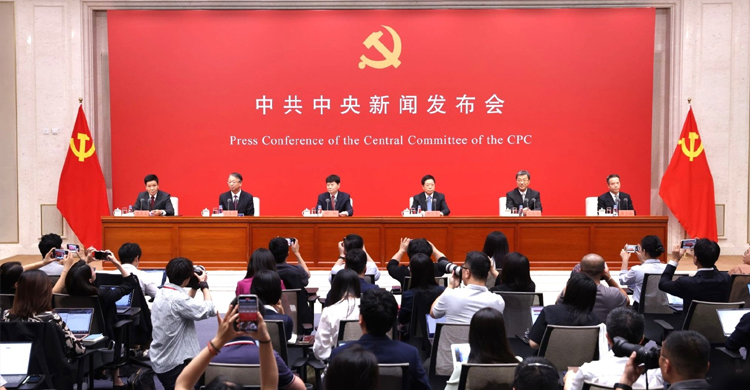
The 20th Central Committee of the Communist Party of China (CPC) convened its fifth plenary session in Beijing from October 26 to 29.
The plenary session was attended by 162 members of the Central Committee and 117 alternate members. Members of the Standing Committee of the Central Commission for Discipline Inspection (CCDI) and leading officials from relevant departments were present in a non-voting capacity. Selected grassroots representatives and scholarly experts among the delegates to the 20th CPC National Congress also attended as non-voting participants.
The session was presided over by the Political Bureau of the Central Committee. Xi Jinping, General Secretary of the CPC Central Committee, delivered an important address.
During the session, participants heard and deliberated upon a work report presented by Xi Jinping on behalf of the Political Bureau of the Central Committee. The plenum deliberated and adopted the "Decision of the Central Committee of the Communist Party of China on Unswervingly Advancing Full and Rigorous Party Self-Governance." General Secretary Xi Jinping provided explanatory remarks on the draft text of the Decision.
The plenum fully endorsed the work of the Political Bureau since the Fourth Plenary Session of the 20th CPC Central Committee. It was unanimously recognized that the Political Bureau has conscientiously implemented the guiding principles of the 20th National Congress and each subsequent plenary session of the 20th Central Committee. Upholding the general principle of pursuing progress while ensuring stability, the leadership has fully, accurately, and comprehensively applied the new development philosophy; coordinated the "Five-Sphere Integrated Plan" and the "Four-Comprehensives" strategic blueprint; balanced domestic and international imperatives; and aligned development with security.
Substantial strides have been made in driving high-quality economic development, advancing socialist democracy and the rule of law, and managing ideological and cultural affairs. Positive achievements were recorded in improving public well-being, ecological conservation, national security, and social stability. Full and rigorous Party self-governance has been deepened, the modernization of national defense and the armed forces accelerated, and affairs regarding Hong Kong, Macao, and Taiwan effectively executed. Major-country diplomacy with Chinese characteristics continued to expand. With the 14th Five-Year Plan successfully concluded, the 15th Five-Year Plan achieved a solid opening, marking fresh progress across Party and state initiatives. Concurrently, educational programs were launched to cultivate and practice the correct outlook on political performance, and the 105th anniversary of the founding of the CPC was commemorated, consolidating the unified resolve of the Party and the Chinese people of all ethnic groups.
Reviewing the Party`s century-long history of struggle, the session underscored that the CPC has advanced from victory to victory because it upholds the noble ideals of communism, remains dedicated to the lasting cause of the Chinese nation, and commits itself to the well-being of the people and national rejuvenation. Throughout every historical phase, the Party has attached paramount importance to Party self-governance, demonstrating the courage to uphold truth, rectify mistakes, and resolve its own problems through its internal strength and popular support, establishing itself as the firm leadership core of the people`s cause. Developing Party building as a "Great Project" and a "New Great Project" through revolution, construction, and reform, the Party has deepened this endeavor in the new era since the 18th National Congress. The Party has arrived at two historic answers to escape the historical cycle of rise and fall: "placing the government under the people`s oversight" and "advancing self-reform"—pioneering achievements that hold lasting significance in Marxist party-building history.
The plenum paid high tribute to the momentous achievements secured in full and rigorous Party self-governance in the new era. It was unanimously observed that the Party Central Committee with Comrade Xi Jinping at its core has acted with immense political courage and a profound sense of mission. Confronted with past vulnerabilities—including lax leadership, hollowed-out structures, weak discipline, and acute intra-Party challenges—the Central Committee unswervingly enforced full and rigorous self-governance. Turning the blade inward and restoring order through strict discipline, the Party systematically resolved chronic shortcomings, eradicated entrenched malpractices, and removed severe hidden hazards within the Party, the state, and the military. Through revolutionary self-forging, the Party has grown significantly stronger, inaugurating a new horizon for the centenary Party`s self-reform, driving historic transformations across Party and state undertakings, and empowering the Party and the people to take the historic initiative in building a powerful country.
The plenum noted that in the great practice of exercising Party self-governance and building a strong Party in the new era, the Central Committee with Comrade Xi Jinping at its core has advanced a series of groundbreaking ideas, views, and strategies addressing the foundational question of "what kind of long-term governing Marxist party to build and how to build it," forming Xi Jinping`s Thought on Party Building. This thought enriches Marxist party-building theory, represents a milestone in theoretical innovation by integrating the basic tenets of Marxism with China`s concrete realities and fine traditional culture, embodies the collective wisdom of the Party and the people, and serves as an integral component of Xi Jinping Thought on Socialism with Chinese Characteristics for a New Era, providing fundamental guidance for deepening the New Great Project of Party building.
The session stressed that while favorable conditions exist for full and rigorous Party self-governance, the Party faces evolving realities and emerging challenges. Profound shifts in global, domestic, and intra-Party conditions make mobilizing the people to safeguard national sovereignty, security, and development interests more arduous. Organizing the people to deepen reform, advance development, and maintain social harmony has grown increasingly complex, as has preserving the Party’s advanced nature and purity. These conditions pose major tests to the Party’s governing capacity, leadership caliber, cadre quality, and anti-corruption resilience. The "four major tests" and "four perils" confronting the Party remain long-term, complex, and severe. The entire Party must recognize the strategic necessity of advancing full and rigorous Party self-governance from the vantage point of consolidating the Party`s long-term governing foundation and realizing national rejuvenation, maintain strategic composure, and apply high-standard, pragmatic measures to consolidate and expand the sound political ecosystem.
The plenum highlighted that unswervingly advancing full and rigorous Party self-governance requires upholding Marxism-Leninism, Mao Zedong Thought, Deng Xiaoping Theory, the Theory of Three Represents, and the Scientific Outlook on Development; comprehensively implementing Xi Jinping Thought on Socialism with Chinese Characteristics for a New Era; and conscientiously studying and applying his Thought on Party Building. Centering on the Party`s central tasks and historical missions, the general requirements for Party building in the new era must be enacted. With the Party Constitution as the fundamental benchmark, the Party must preserve its vanguard nature, uphold its overall leadership and the centralized, unified leadership of the Central Committee, enhance its long-term governing capabilities, preserve its purity, and maintain close ties with the people. Maintaining strict discipline as the defining keynote, the system for full and rigorous Party self-governance must be refined. Taking the Party`s political development as the overarching guide, comprehensive Party building must advance across all fronts, stimulating the vitality, initiative, and creativity of the entire Party, achieving ongoing self-purification, self-perfection, self-renewal, and self-cultivation to ensure the Party remains at the forefront of the times, genuinely supported by the people, and the resolute leadership core of socialism with Chinese characteristics.
The plenum stressed that the core principles guiding full and rigorous Party self-governance include: serving central missions and tasks, prioritizing political development, maintaining comprehensive strictness, adopting a problem-oriented approach, upholding fundamental principles while innovating, setting top-down examples, and governing the Party in accordance with established rules and regulations.
Systematic arrangements were laid down to advance full and rigorous Party self-governance. The plenum stressed the need to enhance Party spirit among communists, rigorously enforce democratic centralism, build a high-caliber cadre team capable of shoulder-to-shoulder dedication to national rejuvenation, create an interconnected and highly executable organizational apparatus, continuously improve conduct, strictly enforce discipline, advance the coordinated mechanism ensuring officials do not dare, cannot, and have no desire to be corrupt, govern the Party through institutions and regulations, refine Party and state oversight frameworks, and consolidate governance responsibilities.
The session affirmed that cultivating Party spirit is the fundamental task of full and rigorous self-governance. All Party members and cadres must remain true to the Party`s nature and founding mission, heighten their consciousness as vanguard fighters, and treat the cultivation of Party spirit as a lifelong pursuit. They must consolidate ideals and convictions, remain fiercely loyal to the Party, stay devoted to the people, uphold pragmatic approaches, preserve moral integrity, and embody loyalty, cleanliness, and accountability. Political loyalty education must be intensified, minds anchored by the Party`s innovative theories, Party spirit nurtured through fine revolutionary traditions and cultural heritage, tested through practical struggle, and subjected to rigorous assessment.
The plenum stated that democratic centralism constitutes the Party`s foundational organizational principle and institutional system, and its strict implementation is an intrinsic demand of self-governance. Mechanisms supporting democratic centralism must be perfected, intra-Party democracy fully developed, correct centralism effectively applied, and the political, organizational, institutional, and operational advantages of democratic centralism maximized. The centralized, unified leadership of the CPC Central Committee must be upheld and reinforced, the quality of intra-Party democracy elevated, decision-making protocols strictly followed, and oversight over the exercise of power by principal leaders reinforced.
The plenum underscored that strictly managing cadres is pivotal to Party self-governance. The Party’s organizational line for the new era must be implemented, with strict standards maintained across cadre education, training, selection, appointment, management, and supervision to build an elite corps distinguished by political conviction, exceptional competence, fine conduct, and strict discipline. Upholding correct appointment standards, cadre selection must be conducted scientifically, encouraging cadres to pursue tangible contributions for the public good, enhancing their professional capabilities, refining mechanisms for cultivating young talent, strengthening operational supervision, and comprehensively cultivating, attracting, and deploying talent.
The session highlighted that Party organizations at all levels form the structural backbone of Party self-governance. Institutional efforts must advance Party building across all tiers and sectors, strengthening the political and organizational functions of Party units to ensure the Party`s line, principles, and Central Committee decisions are executed with precision and efficiency. The exemplary role of Party branches in central and state organs must be leveraged, the role of local Party committees strengthened, grassroots Party building advanced systematically across sectors, targeted attention devoted to emerging economic and social domains, the quality of Party membership elevated, and connectivity across Party hierarchies reinforced.
The plenum added that rectifying conduct and enforcing discipline serve as potent instruments of self-governance. Party spirit, conduct, and discipline must be addressed concurrently, linking conduct rectification and discipline enforcement with anti-corruption efforts. Unswervingly upholding the Party`s mass line, the spirit of the Central Committee`s eight-point decision on conduct must be enacted persistently, institutionalizing conduct improvement, strictly enforcing discipline, and utilizing disciplinary education to restrain, guarantee, and incentivize action.
The session affirmed that advancing the simultaneous strategy ensuring officials do not dare, cannot, and have no desire to be corrupt is an integral policy and the fundamental guideline of the anti-corruption struggle. Remembering that the Party represents the working class and the broadest public interest with no private interests of its own, the Party is intrinsically incompatible with corruption. Firmly following the Chinese path of combating corruption, the centralized and unified leadership of the Central Committee over anti-corruption operations must be reinforced, addressing both symptoms and root causes through institutional remedies, rigorous penalties, targeted rectification, and integrated prevention. High pressure against corruption must be maintained, checks and oversight on power execution intensified, the ideological basis for integrity consolidated, and the holistic efficacy of the anti-corruption mechanism enhanced.
The plenum recognized that strengthening intra-Party regulations is a long-term, foundational strategy for Party governance. Taking the Party Constitution as the fundamental code of conduct, reforms in the Party-building institutional framework must be deepened, advancing the organizational unity of ruling the country by law and governing the Party by regulations, thereby providing solid institutional guarantees for sustained self-governance. Intra-Party regulatory frameworks must be improved, enforcement capacity heightened, and unwritten rules decisively dismantled.
The session emphasized the necessity of improving the oversight system of the Party and the state. Comprehensive oversight by Party committees (Party leadership groups) must be enforced, the dual-leadership system for discipline inspection and supervision refined, intra-Party oversight integrated seamlessly with other oversight channels, and the inspection tour mechanism wielded as an incisive instrument of deterrence.
The plenum underscored that advancing full and rigorous Party self-governance is the shared political duty of the entire Party. Holding fast to the "nose of the ox" in the governance responsibility system, a framework where every tier fulfills its duty through coordinated synergy must be cemented, accountability appraisal systems refined, and rigorous inquiries pursued wherever negligence or serious governance lapses arise.
The session stated that studying, publicizing, and implementing the guiding principles of the plenum represents a paramount political task for the entire Party at present and in the period ahead. Party organizations must organize deep study, reinforce organizational leadership, tackle critical bottlenecks, and transform every measure outlined in the Decision into concrete practice.
The plenum stressed the imperative of effectively handling work for the transition between the closing and upcoming year. Adhering to the principle of seeking progress while maintaining stability, the new development philosophy must be fully applied, the new development paradigm expedited, macro policies properly leveraged, domestic demand potential unleashed, and reform and opening up deepened. Efforts must be sustained to drive economic transformation, ensure the fulfillment of annual economic and social development targets, and secure an auspicious start to the 15th Five-Year Plan. Development and security must be balanced, basic public livelihood nets reinforced, and safety in production, disaster mitigation, food and drug safety, and social stability ensured. Consolidating the outcomes of education on the correct outlook on political performance, targeted training must be conducted for newly appointed leadership members—especially principal officials—guiding them to exercise authority for the public good, make scientific decisions, and pursue tangible achievements grounded in real work.
The plenary session decided that the 21st National Congress of the Communist Party of China will be convened in Beijing in the second half of 2027. The plenum emphasized that the 21st National Congress will be an event of paramount importance convened at a decisive stage when socialist modernization is fundamentally achieved and on the new journey toward the second centenary goal, marking a historic event in the political life of the Party and the state. The entire Party must rally and lead the people of all ethnic groups to strive together, forge new ground in building a modern socialist country through Chinese modernization, and greet the convening of the 21st National Congress with concrete developmental accomplishments.
The plenary session elected Zhang Shengmin as a member of the Political Bureau of the CPC Central Committee.
In accordance with the provisions of the Party Constitution, the plenum decided that alternate members of the Central Committee—Lu Dongliang, Bao Gang, Xing Shanping, Qu Yingfu, Lu Jun, Zhu Tianshu, Zhu Guoxian, Liu Jun, Liu Jie, and Liu Qiang—be elevated to full members of the Central Committee.
The plenum deliberated and endorsed the investigation reports submitted by the CPC Central Commission for Discipline Inspection regarding serious violations of discipline and law by Ma Xingrui, Lan Tianli, Liu Jianchao, Wang Lixia, Jin Zhuanglong, Lei Fanpei, Yi Huiman, Wang Xiangxi, Sun Shaocheng, Li Yongce, Fei Dongbin, Wu Shenghua, Yu Jianfeng, Yuan Jie, Zhang Zhongyang, Wen Gang, Jin Donghan, and Fang Hongwei. It also deliberated and endorsed the investigation reports submitted by the CPC Central Military Commission regarding serious violations of discipline and law by Zhang Youxia, Liu Zhenli, Wang Renhua, Liu Qingsong, Huang Ming, Li Qiaoming, Li Wei, Zhang Hongbing, Wang Haijiang, Zhang Lin, Wang Feng, Liu Faqing, Yang Cheng, Zhong Shaojun, Zhao Xiaozhe, and Fang Yongxiang. The plenum confirmed the prior decisions of the Political Bureau to expel from the Party Ma Xingrui, Zhang Youxia, Liu Zhenli, Lan Tianli, Liu Jianchao, Wang Lixia, Jin Zhuanglong, Lei Fanpei, Yi Huiman, Wang Xiangxi, Sun Shaocheng, Wang Renhua, Liu Qingsong, Huang Ming, Li Qiaoming, Li Wei, Zhang Hongbing, Wang Haijiang, Zhang Lin, Wang Feng, Liu Faqing, Yang Cheng, Zhong Shaojun, Zhao Xiaozhe, Fei Dongbin, Wu Shenghua, Yu Jianfeng, Yuan Jie, Zhang Zhongyang, Wen Gang, Jin Donghan, Fang Hongwei, and Fang Yongxiang, as well as the decision to dismiss Li Yongce from his intra-Party posts.
The plenary session called upon the entire Party to rally even more closely around the CPC Central Committee with Comrade Xi Jinping at its core, fully implement Xi Jinping Thought on Socialism with Chinese Characteristics for a New Era, govern the nation with diligence, advance full and rigorous Party self-governance unswervingly, continually create new milestones in Party governance and national prosperity, and wage untiring struggle to build a modern socialist country in all respects and advance the great rejuvenation of the Chinese nation through Chinese modernization.
Source: Shwarna, Touhid, Lily | China Media Group (CMG)