MM Rahmatullah: Dhaka-6 lawmaker Ishrak Hossain has accused the ousted Awami League government of preventing his father, BNP leader and former Dhaka mayor Sadeque Hossain Khoka, from returning to Bangladesh alive, despite his application for a new passport in 2017.
The allegation has drawn renewed attention following reports that former Prime Minister Sheikh Hasina, who fled to India after the July 2024 mass uprising, has sought a new Bangladeshi passport and national identity card (NID), reportedly as part of preparations for a possible return home in December.
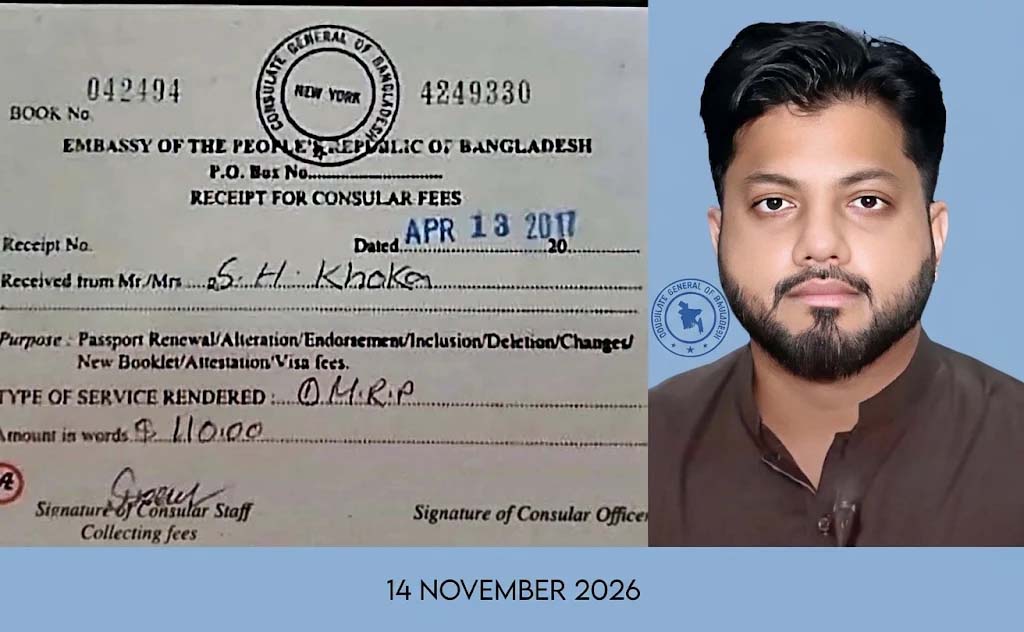
In a Facebook post on Saturday, Ishrak said his father had applied for a new passport after his previous passport expired in 2017. However, he alleged, the then government did not allow Khoka to return to Bangladesh during his lifetime.
"Sheikh Hasina and her government did not allow him to return alive," Ishrak wrote, making a strong accusation against the former prime minister.
He also demanded that Hasina be brought back to Bangladesh to face justice.
"We want the mass-murderer Hasina back alive. We want to bring her to justice," he said in his post.
Sadeque Hossain Khoka, a BNP vice-chairman and former mayor of the undivided Dhaka City Corporation, died of cancer on November 4, 2019, while undergoing treatment in New York, the United States. He had spent a prolonged period in the US before his death.
His inability to return home before his death remains a politically sensitive issue, particularly among BNP leaders and supporters.
Meanwhile, reports that Sheikh Hasina has sought new travel and identity documents have triggered widespread discussion in Bangladesh`s political circles.
According to a Reuters report by its correspondent Krishna N. Das, Hasina`s legal representatives submitted a letter on November 9 requesting the issuance of a new passport and NID for the former prime minister.
The letter was reportedly sent by London-based legal firm Matrix Chambers to Priti Rahman, acting High Commissioner of Bangladesh in New Delhi.
It reportedly argued that Hasina`s previous passport and NID had been cancelled by the interim government and requested that new documents be issued on the basis of her Bangladeshi citizenship and the country`s international human rights obligations.
The Bangladesh High Commission in New Delhi has confirmed receiving an email concerning the request.
Mohammad Saidur Rahman, press minister at the High Commission, told that the email had come from Matrix Chambers and that the matter had been communicated to the Ministry of Foreign Affairs in Dhaka.
However, he said the mission had not independently verified whether the request had actually been made on Hasina`s behalf or whether Matrix Chambers was formally authorised to represent her.
The development has fuelled speculation about Hasina`s possible return to Bangladesh in December, although no confirmed date for such a return has been announced.
The Bangladesh government has already indicated that it will not issue a new passport to Hasina.
Foreign Affairs State Minister Humayun Kobir reportedly made it clear that Bangladesh would not provide her with a new passport.
The government`s position is that Hasina, who faces serious criminal charges and has been convicted in Bangladesh, should be returned through the existing extradition arrangements between Dhaka and New Delhi to face the judicial process.
The issue has therefore become more than a question of passport issuance. It involves the country`s legal obligations, bilateral relations with India and the demand for accountability over the violence during the July 2024 uprising.
A BBC report published on Friday suggested that Hasina`s continued presence in India has increasingly become a diplomatic and political concern for New Delhi.
According to the report, India`s position has become complicated by the impact of her presence on bilateral relations with Bangladesh and criticism in the international arena over its decision to shelter a former leader facing serious allegations.
The report suggested that allowing Hasina to move to a third country had previously been explored but had not succeeded for various reasons.
Against this backdrop, returning to Bangladesh to face the judicial process is increasingly being viewed in Delhi as a potentially realistic option.
The report also indicated that Indian policymakers believe Hasina`s return could have implications for the political future of the Awami League, a longtime political ally of India.
Citing officials in Delhi, the BBC outlined two conditions that India would reportedly like Bangladesh to consider before facilitating her return.
The first concerns the logistics of her transfer. Since Hasina arrived in India aboard a Bangladeshi military aircraft, Indian officials reportedly believe that the Bangladesh Army should also take responsibility for bringing her back.
This could be arranged either by sending a military aircraft to New Delhi or through a designated point along the land border. India, according to the report, would be prepared to provide the necessary logistical arrangements.
The second condition reportedly concerns legal guarantees. India wants assurances that Hasina would have an opportunity to appeal against her death sentence and that proceedings relating to the July massacre allegations could be conducted afresh.
Indian officials are also reportedly concerned that any such demand should not be perceived as interference in Bangladesh`s independent judicial process.
One Indian Foreign Ministry official, quoted by the BBC, said New Delhi would not knowingly facilitate a situation in which Hasina was sent back to face execution without an opportunity for a fair judicial process.
India would also reportedly want the proceedings to take place under international and global media scrutiny.
According to the BBC report, New Delhi has been holding behind-the-scenes discussions with Dhaka for several months to explore a possible way forward.
However, neither the reported conditions nor the discussions should be regarded as a formally agreed arrangement between the two governments.
For Bangladesh, the issue touches on several critical questions: accountability for the deaths and violence during the July uprising, the independence of the judiciary, the country`s extradition arrangements and its future relationship with neighbouring India.
Ishrak Hossain`s remarks have added another emotional dimension to the debate by recalling the fate of his father, who died abroad after failing to return home.
As discussions over Hasina`s possible return continue, the government faces growing public interest in how the matter will be handled while balancing justice, national sovereignty and diplomatic considerations.