MT Desk: India’s acquisition of French Rafale fighters was once hailed as a game-changer. But reports of Rafales being shot down during the May 2025 aerial battle with Pakistan have dented their aura of invincibility. While Dassault Aviation has not publicly withdrawn from the Indian market, commentators argue that the episode has complicated India’s procurement narrative.
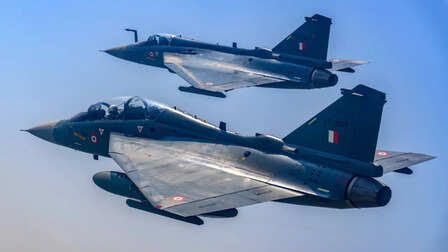
Critics suggest that India’s reliance on foreign imports is expensive and politically fraught, yet indigenous alternatives like Tejas are struggling to deliver.The Tejas crash has reignited debate about India’s wider indigenous defence programs. Commentators point to a pattern of underperformance:Main Battle Tank Arjun: Despite decades of development, the Arjun has faced weight and mobility issues. Its induction has been limited, with the Army preferring imported or up-graded T 90 tanks.
Missile Systems Akash and Prithvi: While operational, these systems are often described as outdated compared to modern equivalents. Questions persist about their survivability against advanced electronic warfare and missile defence systems.Tejas Fighter: The crash reinforced perceptions of fragility, compounded by delays and lim-ited export prospects. Together, these programs highlight the difficulty of achieving true self-reliance in defence production.
Meanwhile, Pakistan’s JF 17 success demonstrates the advantages of collaborative develop-ment. By partnering with China, Pakistan has leveraged economies of scale, shared technol-ogy and political backing to produce a fighter that is both affordable and exportable.
For India, the lesson is stark: self-reliance without efficiency risks irrelevance.The timing of the crash also matters in the wider Indo-Pacific. China is expanding its carrier operations, Pakistan is marketing its fighters and India is struggling to maintain squadron strength. In such an environment, India’s credibility as a regional security provider is weak-ened.
If India cannot field reliable indigenous systems, it risks becoming dependent on imports at a time when strategic autonomy is most needed. Beyond the technical failures, the Tejas crash has triggered a crisis of confidence. Defence analysts argue that India’s defence establish-ment has often prioritized symbolism over substance — unveiling ambitious projects without ensuring production efficiency or operational reliability.
The Arjun tank, Akash missile and Tejas fighter were all meant to symbolize India’s rise as a defence innovator. Yet each has struggled to meet expectations. The Dubai crash crystallized these doubts, forcing policymakers to confront the uncomfortable reality that India’s defence industry may not yet be ready to compete on the global stage. The path forward requires introspection and reform. India must:
Streamline procurement and production: Reduce bureaucratic delays and ensure timely delivery of platforms.Invest in R&D partnerships: Consider selective collaborations with trusted partners to ac-celerate technology transfer.
Prioritize reliability over symbolism: Focus on producing fewer but more dependable sys-tems rather than chasing ambitious numbers.Strengthen testing and quality assurance: Ensure that platforms showcased abroad are bat-tle-ready and resilient.
India’s goal of achieving 42 squadrons now looks increasingly unattainable. Rafale’s tar-nished image, combined with the underperformance of indigenous programs like Arjun, Akash and Prithvi, underscores the depth of India’s challenges. Unless India can reform its defence industrial base, streamline production and deliver reliable systems, its dream of self-reliance will remain elusive. The Dubai crash was not just an accident — it was a wake-up call.