MM Rahmatullah: Bangladesh Jamaat-e-Islami Secretary General Professor Mia Golam Parwar has alleged that conspiracies similar to those that led to the historic defeat at the Battle of Plassey in 1757 are still active in present-day Bangladesh, warning that individuals acting against national interests continue to exist despite the absence of a modern-day Mir Jafar.
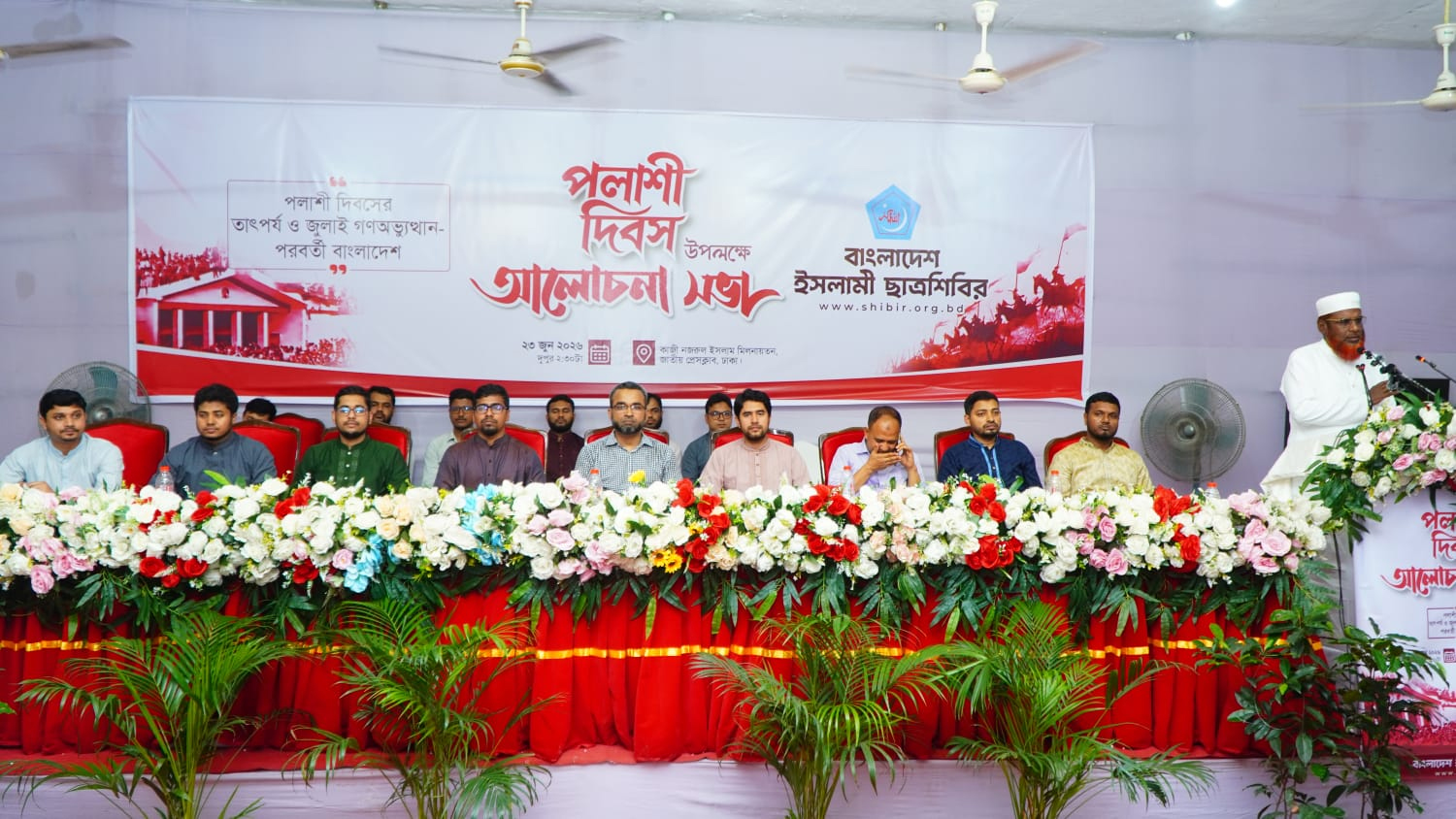
Speaking as the chief guest at a special discussion titled “The Significance of Plassey Day and Bangladesh After the July Mass Uprising” at the Kazi Nazrul Islam Auditorium of the National Press Club on Monday, Parwar said the lessons of Plassey remain highly relevant in contemporary politics.
“The history of Plassey is not confined to an event on the banks of the Bhagirathi River. Similar conspiracies are taking place today on the banks of the Padma, Meghna, Jamuna and Buriganga rivers,” he said. “Mir Jafar may no longer exist by name, but many individuals with Mir Jafari characteristics are still working against the interests of the nation.”
Referring to the defeat of Nawab Sirajuddaula on June 23, 1757, Parwar said the loss of Bengal’s independence was primarily caused by internal betrayal rather than external aggression. “Enemies within are often more dangerous than enemies from outside. The history of Plassey is a history of betrayal driven by the lust for power,” he remarked.
He added that the setback at Plassey did not extinguish the aspiration for freedom but instead paved the way for future struggles that eventually culminated in the historic developments of 1947 and 1971.
Parwar also argued that modern forms of domination no longer depend on direct territorial occupation. Instead, influence is exerted through economic, political, cultural and policy-related control. As a result, he said, safeguarding genuine independence and national sovereignty remains one of the country’s greatest challenges.
Drawing a connection with the July mass uprising, he claimed that the movement reflected the people’s renewed commitment to protecting national interests and independence. However, he alleged that efforts are currently underway to undermine those aspirations.
Presiding over the event, Bangladesh Islami Chhatra Shibir President Nurul Islam emphasized what he described as the strong historical connection between the lessons of Plassey and the realities of Bangladesh following the July uprising.
He said history repeatedly witnesses the re-emergence of figures comparable to Ghaseti Begum, Omichand and Rai Durlabh, who create internal divisions and serve the interests of external powers. According to him, “Mir Jafari characters” have repeatedly appeared in Bangladesh’s political history, acting against public interests while advancing foreign or hegemonic agendas.
Nurul Islam further stated that the tragedy of Plassey was not an isolated incident but a reflection of enduring patterns of internal division, self-serving politics and the pursuit of power.
Referring to the Great Bengal Famine of 1770, he argued that colonial rule and exploitative economic policies had caused immense human suffering. He claimed that traces of similar exploitative structures can still be observed in certain contemporary political and economic decisions.
He stressed that protecting national sovereignty requires more than slogans, calling for patriotism, sacrifice and responsible citizenship across economic, political, cultural and social spheres. He said Chhatra Shibir is working to develop an honest, skilled and patriotic generation capable of safeguarding national interests.
The discussion was chaired by Nurul Islam and moderated by Chhatra Shibir Secretary General Sibgatullah. Among the speakers were former Chhatra Shibir president and Member of Parliament Salahuddin Ayoubi, Professor Dr. Mohammad Bilal Hossain of the Department of History at Jagannath University, and writer-researcher Dr. Sayeed Wakil.
Several central leaders of the organization, including Office Secretary Azizur Rahman Azad, Literature Secretary Saidul Islam, Publication Secretary Amirul Islam, Arts and Culture Secretary Abu Musa, and Baitul Mal Secretary Anisur Rahman, were also present at the event.