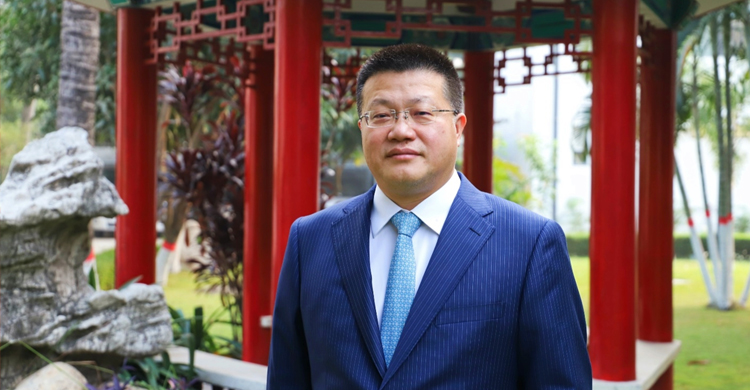
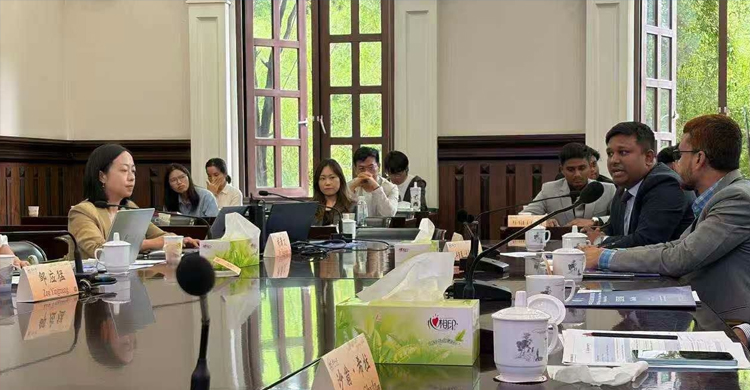
International: Bangladesh Prime Minister Tareque Rahman’s upcoming visit to China is expected to elevate bilateral relations to a new historic stage and further consolidate the foundation for what could become the “next golden era” of Bangladesh-China ties, according to Chinese Ambassador to Bangladesh Yao Wen.
In an article published in one of Bangladesh’s leading media outlets, Ambassador Yao shared his vision for the future of relations between the two countries.
He emphasized that China has always treated all nations equally, regardless of their size, strength, or economic status, and remains committed to the principles of mutual respect, equality, and win-win cooperation.
Diplomatic Ties and Historical Foundations
Since the establishment of diplomatic relations on October 4, 1975, ties between China and Bangladesh have steadily deepened. High-level exchanges and political interactions have continued to expand over the years.
According to the ambassador, several visits to China by former Prime Minister Khaleda Zia played an important role in strengthening bilateral relations and giving them unique depth. China views Bangladesh as an important partner in its journey toward development and believes that both countries have consistently supported each other on issues concerning their core interests.
Trade and Economic Partnership
China has remained Bangladesh’s largest trading partner for the past 16 years. The duty-free access granted by China to Bangladeshi products, covering 100 percent of tariff lines, will remain in effect until 2028.
At present, more than 700 Chinese companies are investing in Bangladesh across sectors such as power, infrastructure, textiles, information and communication technology, and energy, creating employment opportunities for thousands of people.
In particular, China-Bangladesh joint projects have contributed to the development of more than one gigawatt of electricity generation capacity, playing a significant role in supporting the national grid and meeting the country`s growing power demand.
Key Areas for Future Cooperation
In his article, Ambassador Yao highlighted several priority areas for future collaboration:
Trade and Investment: Expanding bilateral trade and increasing investment in emerging sectors.
High Technology: Strengthening cooperation in artificial intelligence, the digital economy, and ICT.
Green Development: Promoting environmentally friendly technologies and sustainable development.
Social Sectors: Launching new initiatives in education, healthcare, skills development, and cultural exchanges.
Global Governance and Multilateral Cooperation
The ambassador noted that Bangladesh plays an important role in safeguarding the interests of developing countries, particularly on issues such as climate change and sustainable development.
He expressed hope that Bangladesh and China would further strengthen cooperation within multilateral platforms, including the United Nations and the World Trade Organization.
According to Yao Wen, unprecedented progress in three key areas—political mutual trust, economic cooperation, and people-to-people exchanges—will further reinforce Dhaka-Beijing relations.
Observers believe that the Prime Minister’s visit will ultimately take Bangladesh-China relations to a new level and deepen the longstanding friendship between the peoples of the two countries.
Information and Photo: Embassy of the People’s Republic of China in Bangladesh.