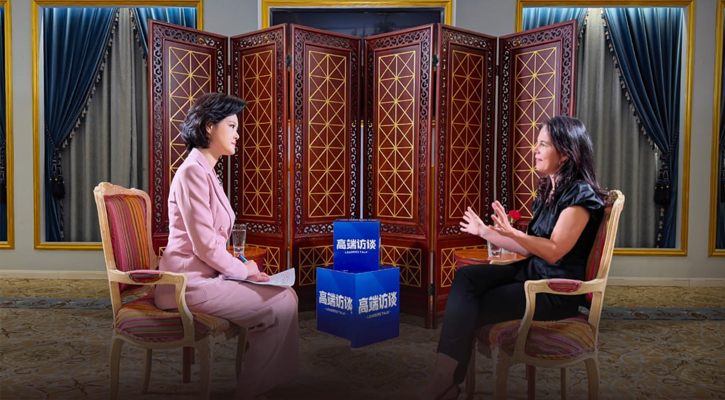
International: Annalena Baerbock was elected President of the 80th session of the United Nations General Assembly in September 2025. On April 30, 2026, during her visit to Beijing, she gave an exclusive interview to China Media Group (CMG).
Speaking about the purpose of her visit to China, Baerbock said that at a time when the current international system and multilateralism are facing various challenges, the responsibility of the President of the UN General Assembly is to uphold the UN Charter and protect the three core pillars of the United Nations — peace and security, sustainable development, and human rights.
“I call for building interregional alliances so that we can collectively safeguard multilateralism. This is why I am visiting China. China is one of the founding members of the United Nations and a strong supporter of multilateralism,” she said.
China’s Role in Climate Action
Discussing China’s achievements in environmental protection and efforts to address climate change, Baerbock said tackling climate change is of critical importance.
She said climate action is not only a matter of a country’s own development but also plays a vital role in guiding the world toward a sustainable future.
“Unfortunately, some countries have fallen behind in fulfilling their commitments under the Paris Agreement’s climate goals and their nationally determined contributions. However, the climate crisis remains one of the most serious security challenges facing humanity,” she said.
“Therefore, we must work together, and during my visit to China, I have witnessed tangible examples of such cooperation,” Baerbock added.
UN Reform Necessary, But No Alternative to the Organization
Speaking on the 80th anniversary of the establishment of the United Nations in 2025 and the issue of reforming the organization, Baerbock said the UN is more important today than ever before.
“If there were no diplomatic institution like the United Nations to safeguard peace and security, we would have to create one,” she said.
Baerbock acknowledged that the United Nations needs profound reform, comparing the organization’s development to that of a person who grows from childhood and continuously adapts and matures with time.
However, she sent a clear message to those who seek to use UN reform and its existing limitations as political tools.
“A world without the United Nations would never be a better world,” she said.
She noted that last year alone, 125 million people relied on UN food assistance. Without support from the United Nations and UNICEF, more than 25 million children, particularly in conflict-affected regions, would have been deprived of access to education.
She also highlighted that without the UN system, international civil aviation safety would face major challenges, as global aviation standards and safety oversight are managed through UN-affiliated organizations.
“Therefore, strengthening the United Nations is in the common interest of all of us,” Baerbock said.
Implementing the 2030 Sustainable Development Agenda
Regarding the implementation of the 2030 Sustainable Development Agenda, Baerbock said greater emphasis must be placed on action rather than words and that commitments must be translated into concrete results.
She said the primary responsibility lies with member states.
“The United Nations serves as a platform that brings countries together, enabling them to make commitments and work toward fulfilling them,” she said.
UN’s Role in AI Governance
Speaking about the role of the United Nations in establishing governance frameworks for artificial intelligence (AI), Baerbock said the UN is the only platform capable of bringing together governments, AI companies and all relevant stakeholders to reach consensus and build a common global governance structure.
“If we fail to ensure, through effective regulation and oversight, that artificial intelligence is used for human welfare and does not harm societies, it would go against the shared interests of all humanity,” she said.
Baerbock pointed out that a digital divide still exists globally, with unequal access to technological resources among countries, while major technology companies hold dominant positions in the market.
“International cooperation is essential to bridge the digital divide,” she said.
China’s Contribution to Protecting International Order and Multilateralism
Commenting on China’s role in safeguarding the international order and multilateralism, Baerbock said China’s contribution is highly significant.
She said permanent members of the UN Security Council not only have the power to exercise veto authority but also carry the responsibility and obligation to uphold the UN Charter.
“The founding vision of the United Nations was precisely this — the primary role of the Security Council is to maintain peace and security and avoid double standards,” she said.
Baerbock added that regardless of which country commits aggression, equal measures should be taken against it.
“China, along with the other four permanent members of the Security Council, plays a central role in this process,” she said.
Source: Shishir, Alim and Anupama, China Media Group (CMG).