DU Correspondent: Bangladesh Islami Chhatra Shibir has demanded justice for 241 of its leaders and activists allegedly subjected to enforced disappearance during the previous government’s tenure, while calling for the whereabouts of seven student leaders who remain missing.
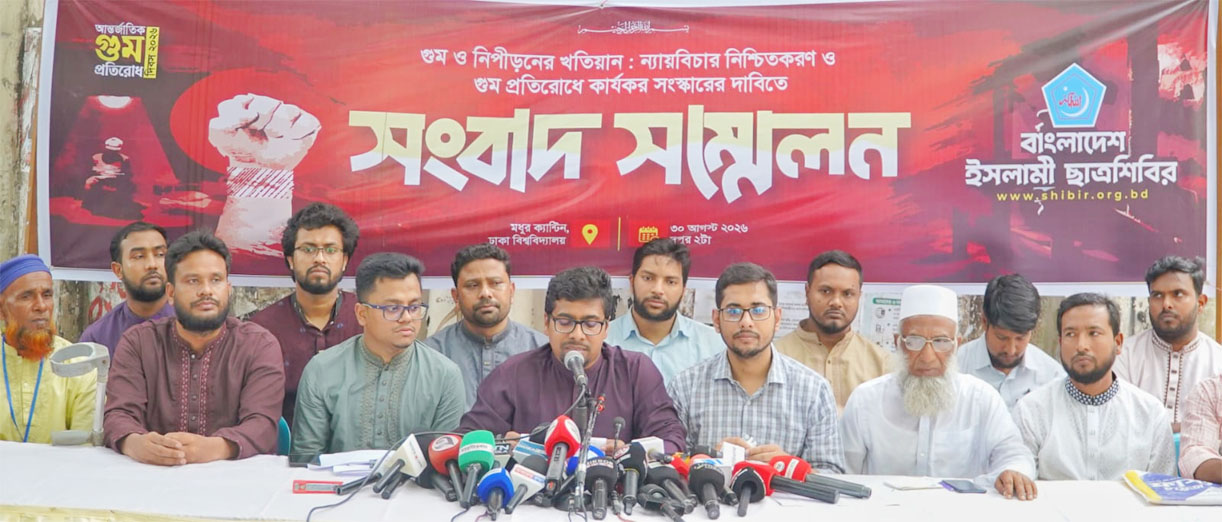
The demands were made at a press conference held at Madhur Canteen of Dhaka University on Sunday, August 30, marking the International Day of the Disappeared.
The press conference was titled “A Record of Enforced Disappearances and Repression: Ensuring Justice and Demanding Effective Reforms to Prevent Enforced Disappearances.”
Shibir Central President Nurul Islam presented the written statement.
Among others, Central Office Secretary Azizur Rahman Azad, Publicity Secretary and Dhaka University Central Students’ Union (DUCSU) General Secretary S M Farhad, Dawah Secretary Hafiz Abu Musa, Information and Human Rights Secretary Tanzir Hossain Jewel, Student Welfare Secretary Rezaul Karim Shakil, International Secretary Asif Abdullah, Sports Secretary Mushfiqur Rahman and Arts and Culture Secretary Zakir Hossain were present.
Family members of alleged victims and survivors of enforced disappearance and torture also attended the event. They included Maulana Abdul Halim, father of Al Mukaddas, a talented student of Islamic University who allegedly disappeared; Ziaur Rahman, brother of Hafiz Zakir Hossain; Ripon Hossain, elder brother of Rezwan Hossain; Shahidul Islam, brother of Mahidul Islam, who was allegedly killed in a staged “crossfire” after being disappeared; and former Joypurhat district Shibir president Abu Zar Giffari, who, according to the organisation, was shot in the legs and permanently disabled.
In his written statement, Nurul Islam alleged that after the previous government came to power in 2009, enforced disappearance and extrajudicial killings were used as a planned state policy to suppress political dissent.
He alleged that various specialised state agencies, including the Detective Branch (DB), Directorate General of Forces Intelligence (DGFI), Rapid Action Battalion (RAB) and Counter Terrorism and Transnational Crime (CTTC), were used in such operations.
Citing the final report of the Commission of Inquiry on Enforced Disappearances, Nurul Islam said 241 Shibir leaders and activists were among those allegedly disappeared because of their political identity during the previous regime.
According to him, the figure represents 25.42 percent of the total victims identified as having political affiliations, or more than one-fourth of the victims in that category.
He, however, claimed that the actual number of Shibir leaders and activists subjected to enforced disappearance over the past 15 years was more than 700.
Nurul Islam said the figure of 241 was based mainly on information formally submitted to the Commission of Inquiry. He added that it had not yet been possible to fully update information about many people who returned after disappearance but later left the country because of severe psychological trauma, fear and security concerns.
As a result, he claimed, the actual number could be considerably higher than the figure contained in the commission’s report.
Nurul Islam also claimed that information published in what he described as controlled media during the previous government’s tenure showed that 17,463 Shibir leaders and activists were arrested in 14,826 political and allegedly false cases. He said the actual number of arrests was likely higher.
The Shibir president also described several alleged cases of torture and extrajudicial killing involving its leaders and activists, including Abdullah Omar Nasib Shahadat, Ibnul Islam Parvez, Anisur Rahman, Al Mahmud, Abu Zar Giffari, Shamim Mahmud, Hafiz Md Jasim Uddin Jihad, Mahiuddin Sohan and Md Maidul Islam.
He also recalled the alleged shooting and permanent disabling of former Joypurhat district president Abu Zar Giffari and secretary Omar Ali.
Speaking about the seven missing student leaders, Nurul Islam said two years after the July-August 2024 mass uprising, the state had still been unable to provide information about their whereabouts.
The seven missing individuals, according to Shibir, are Md Waliullah, former finance secretary of the Islamic University unit; Al Mukaddas, former cultural secretary of the same unit; Hafiz Zakir Hossain, former president of Adabar thana unit; Rezwan, former secretary of Benapole thana unit; Zainal Hossain of Bandarban; Md Kamruzzaman of Jhenaidah; and Shafiqul Islam, who allegedly disappeared from Cox’s Bazar.
“We are demanding an immediate and specific explanation from the state regarding these seven individuals and their whereabouts,” Nurul Islam said.
Six-point demand: The organisation placed a six-point set of demands at the press conference.
It demanded a fair and impartial investigation into every alleged enforced disappearance involving the 241 Shibir leaders and activists whose cases were submitted to the commission, as well as the organisation’s claim of more than 700 disappearances. It also called for investigations into cases involving ordinary citizens and activists of other political parties.
Shibir further demanded that those who allegedly planned ordered or facilitated enforced disappearances and killings under state patronage—including officials and commanders of law-enforcement agencies whose orders allegedly led to such crimes—be brought to justice before a special tribunal.
The organisation demanded that the state provide clear answers about the fate and whereabouts of the seven missing student leaders and ensure rehabilitation and financial compensation for victims and families of those who were killed.
It also called for amendments to the proposed Enforced Disappearance Prevention and Redress Act, 2026, the National Human Rights Commission Bill and the RAB-related Bill before they become final laws, arguing that the legal framework must guarantee genuinely independent investigations into allegations against security forces.
Shibir also demanded that investigations be assigned to an independent institution outside the chain of command of any force that could potentially be accused in such cases.
The organisation further called for giving the National Human Rights Commission full authority to conduct independent investigations through its own investigative team, with powers similar to those available under the Code of Criminal Procedure. It demanded that the existing obligation to refer complaints back to the concerned security agency be abolished.
At the press conference, relatives of people allegedly subjected to enforced disappearance, as well as injured and disabled Shibir activists, shared their experiences.
They described alleged incidents of disappearance, torture and attacks and called for impartial investigations, punishment of those responsible, rehabilitation of affected families and justice for the victims.
Concluding his remarks, Nurul Islam urged journalists to highlight the suffering of the families who have spent years waiting for their missing loved ones.
He said the families of the seven missing people were still waiting for their children and relatives, adding that the mothers of Al Mukaddas and Md Waliullah continued to look toward their doors in the hope that their sons would return.
He expressed the hope that the media would bring the anguish and suffering of these families to the attention of the highest level of the state.