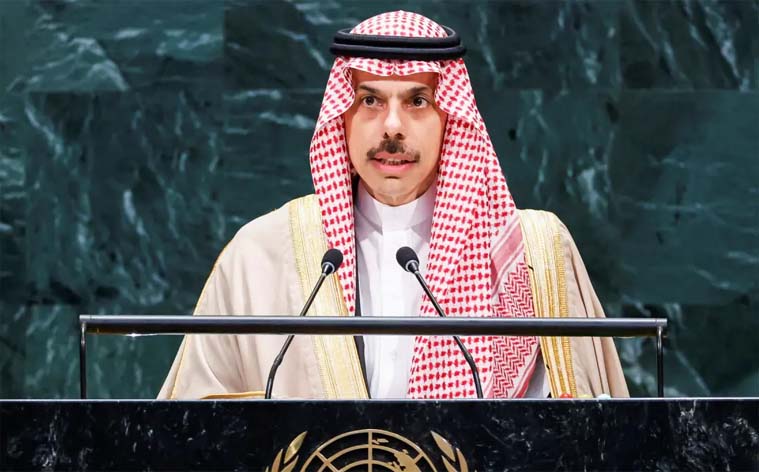
CN, NEW YORK: Saudi Foreign Minister Prince Faisal bin Farhan has called on the international community to take the security of the Gulf and the wider Middle East seriously, warning that threats to the region’s waterways could have far-reaching consequences for global energy supplies, trade and supply chains.
Addressing the 81st session of the United Nations General Assembly in New York, Prince Faisal said the world was facing “rapidly evolving and unprecedented challenges” and stressed that sustainable regional relations must be based on mutual respect, good neighbourliness, respect for sovereignty and compliance with international law.
His remarks came amid heightened tensions in the Middle East, including attacks involving Iran and Yemen’s Houthi movement and continuing concerns over the security of the Strait of Hormuz, the Bab Al-Mandab Strait, the Red Sea and the Gulf of Aden. Saudi Arabia has also been engaged in international and regional consultations over maritime security and de-escalation.
“Any attempt to build sustainable relations among countries in the region can’t be based on domination, influence or the exploitation of crises,” the Saudi minister said.
Instead, he said, regional relations should be founded on “mutual respect, common interests, good neighbourliness” and respect for the sovereignty of states.
Prince Faisal placed particular emphasis on freedom of navigation, saying the stability of the Middle East was directly connected to global energy security, international trade and the resilience of global supply chains.
He called for the protection of navigation through key international waterways, particularly the Strait of Hormuz and Bab Al-Mandab.
Saudi Arabia, he said, rejects attempts by any party to use vital waterways as instruments of pressure or threats. He also rejected any attempt to impose fees or transit conditions on civilian vessels passing through the Strait of Hormuz.
The issue has assumed greater importance amid continuing tensions surrounding the strategic waterway. Regional governments have repeatedly stressed the need to preserve safe navigation and prevent further disruption to international shipping.
Prince Faisal said safeguarding maritime routes and supply chains was a shared international responsibility requiring sustained cooperation.
The Saudi foreign minister also condemned attacks by Yemen’s Houthi movement and welcomed a recent UN Security Council condemnation of Houthi missile and drone attacks against Saudi Arabia.
He urged the international community to reject attacks that, according to Riyadh, threaten Saudi security as well as navigation in the Red Sea and Bab Al-Mandab.
The issue has become an international concern because the Red Sea and Bab Al-Mandab are important routes for global shipping. Prince Faisal recently said the threat posed by the Houthis was not limited to Saudi Arabia and required an international response.
At the same time, Prince Faisal highlighted Saudi Arabia’s support for diplomatic efforts aimed at reducing regional tensions, specifically referring to mediation efforts involving Qatar and Pakistan.
He said regional security arrangements must be “comprehensive, effective and sustainable” and should address the underlying causes of instability.
Saudi Arabia has participated in several diplomatic consultations on the sidelines of the UN General Assembly, including meetings involving Gulf and other regional countries that discussed containing escalation and protecting freedom of navigation.
He also said the Middle East should be free of weapons of mass destruction and that civilian nuclear programmes should remain subject to international oversight and safeguards.
The Palestinian issue also featured prominently in the Saudi minister’s address.
Prince Faisal condemned what he described as continued suffering of Palestinians in Gaza and the West Bank, attacks on civilians, restrictions on humanitarian assistance, forced displacement and settlement expansion.
He reiterated Saudi Arabia’s opposition to any attempt to displace Palestinians from their land and reaffirmed the Kingdom’s support for a two-state solution as the means of ending the Israeli-Palestinian conflict.
On Yemen, Prince Faisal highlighted Saudi Arabia’s humanitarian and development assistance, saying the Kingdom had provided more than $29 billion in aid to the country.
Regarding Sudan, he said the conflict should be resolved through an intra-Sudanese process based on support for state institutions and the aspirations of the Sudanese people.
He also welcomed the US removal of sanctions on Syria and praised efforts toward the country’s stability, reconstruction and development.
On Lebanon and Iraq, the Saudi minister called for a state monopoly on arms and praised Baghdad’s efforts in this direction.
Energy security was another major element of Prince Faisal’s address.
He said global energy security depends on the ability of countries to withstand disruptions, maintain stable supplies, protect critical infrastructure, diversify supply routes and guarantee freedom of navigation.
During recent disruptions, Saudi Arabia had sought to maintain energy supplies through investments in infrastructure, including the East-West Pipeline, he said.
He also highlighted Saudi efforts to reduce emissions from hydrocarbon production and expand renewable energy, carbon-capture technologies and clean hydrogen.
Prince Faisal said maintaining reliable global trade was essential not only for Saudi Arabia but for the wider international community.
He noted that Saudi Arabia had opened its ports to support the movement of goods and people to neighbouring countries during the current crisis.
Turning to technology, he said Saudi Arabia supported the use of artificial intelligence for humanity and development. He highlighted the Kingdom’s role in international AI capacity-building initiatives and the International Center for AI Research and Ethics in Riyadh under UNESCO’s auspices.
He also praised Saudi Arabia’s Vision 2030, saying it had helped strengthen the Kingdom’s role as a regional and international centre for investment, tourism, industry, technology and logistics.
Concluding his address, Prince Faisal said the challenges confronting the international community could not be resolved by individual states acting alone.
“The challenges confronting us can’t be addressed by any state on its own,” he said, stressing adherence to the UN Charter and international law.
He said Saudi Arabia would continue working with international partners to promote peaceful solutions to crises, sustainable development and regional stability.
The address came as Gulf and other regional countries intensified diplomatic consultations in New York over the security of the Gulf and major maritime routes. A multilateral meeting convened by US President Donald Trump earlier during the UN General Assembly high-level week also focused on regional escalation and freedom of navigation in the Strait of Hormuz and Bab Al-Mandab.