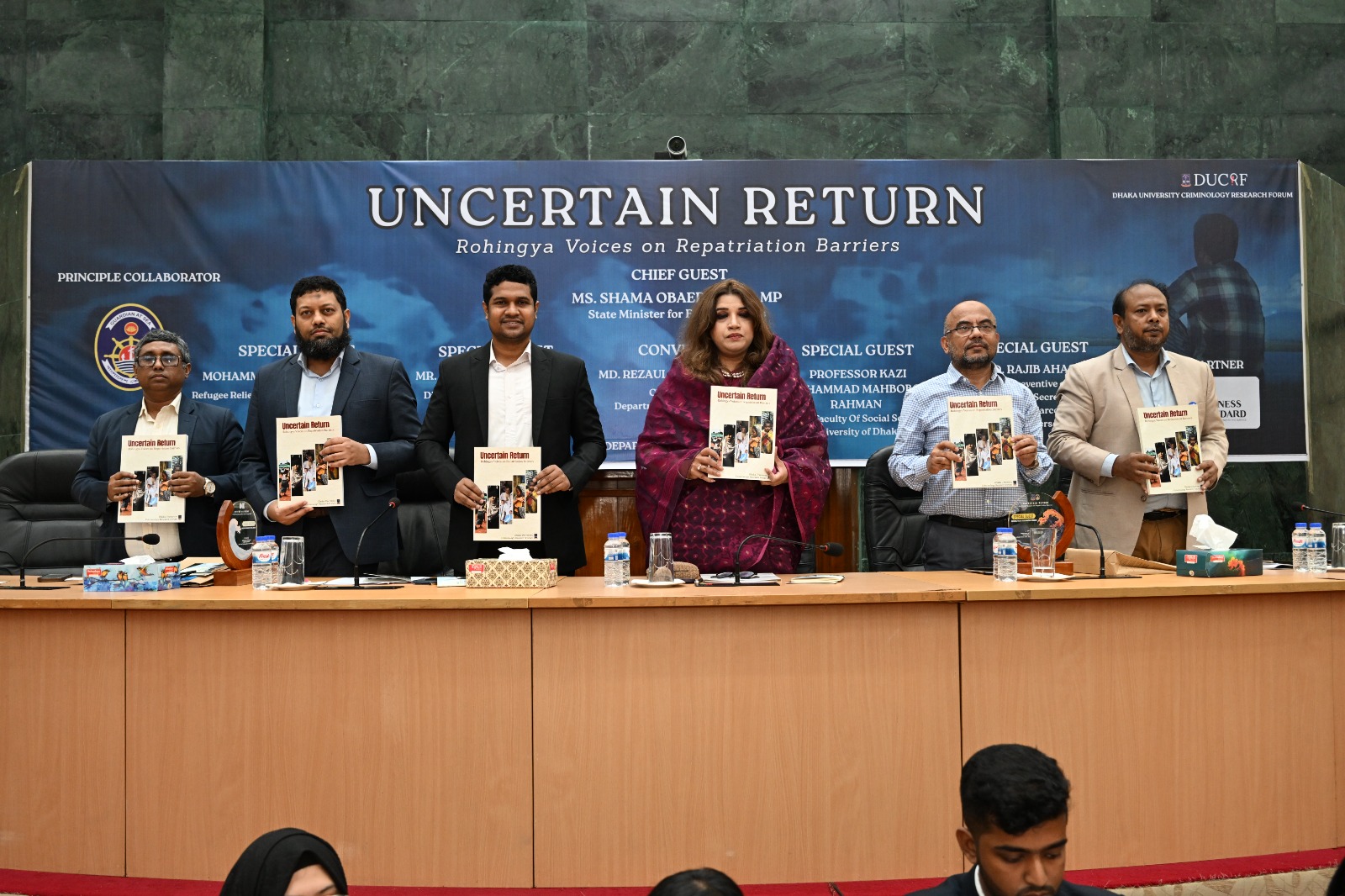
DU Correspondent: State Minister for Foreign Affairs Shama Obaed Islam has called on the international community to move beyond expressions of solidarity and provide actionable, predictable and sustained support to resolve the protracted Rohingya crisis.
She made the call while addressing a national policy dissemination programme titled “Uncertain Return: Rohingya Voices on Repatriation Barriers” as the chief guest at the Senate Bhaban of the University of Dhaka on Wednesday.
The programme was organised by the Department of Criminology and the Criminology Research Forum of the University of Dhaka.
Referring to Prime Minister Tarique Rahman’s address at the 81st United Nations General Assembly, the state minister highlighted five urgent priorities placed before the international community, including a credible roadmap for sustainable repatriation, an end to violence, justice and accountability, and stronger measures against transnational crimes.
She said the government has formed a National Strategy Formulation Committee to help ensure the safe and dignified return of Rohingyas to Myanmar.
Drawing on a study conducted by the Department of Criminology on the prospects and barriers to the return of forcibly displaced Myanmar nationals, Shama Obaed said the Rohingyas were not rejecting Myanmar as their homeland.
“They are rejecting a return to the conditions that forced them to flee,” she said.
The state minister identified recognition and identity, land and property rights, security, and trust backed by credible guarantees as four key pillars of any viable repatriation roadmap.
“Repatriation is an act of trust,” she said, adding that the Rohingyas were “asking for rights, not charity.”
She stressed that the ultimate solution to the Rohingya crisis lies in Myanmar and warned that Bangladesh cannot continue to shoulder the crisis indefinitely.
The state minister urged the global community to translate its statements of support into concrete assistance that is both actionable and predictable.
She also expressed concern over growing crime and insecurity affecting communities in and around the Rohingya camps in Cox’s Bazar.
“This cannot be allowed to become the new normal,” she warned.
The research team earlier presented the findings of its study, which surveyed 816 Rohingya respondents across 17 camp sites in Ukhiya, Cox’s Bazar. The researchers also conducted 72 in-depth interviews with stakeholders directly involved in the repatriation process.
The study sought to examine the concerns, expectations and barriers surrounding the possible return of Rohingyas to Myanmar, providing insights into why many refugees remain uncertain about repatriation.
The findings come at a time when Bangladesh continues to host a large Rohingya refugee population in Cox’s Bazar after successive waves of forced displacement from Myanmar.
The state minister later distributed prizes among the winners of an essay competition organised by the Department of Criminology.
University teachers, researchers, students and other stakeholders attended the programme.