Staff Reporter
Ensuring food security in Bangladesh requires expanding access to food for poor and marginalized communities, reducing agricultural production costs, creating employment opportunities and strengthening social protection programmes. Speakers at a discussion marking World Food Day 2026 stressed the need for coordinated efforts among the government, civil society and non-governmental development organisations to address weaknesses in the food system.
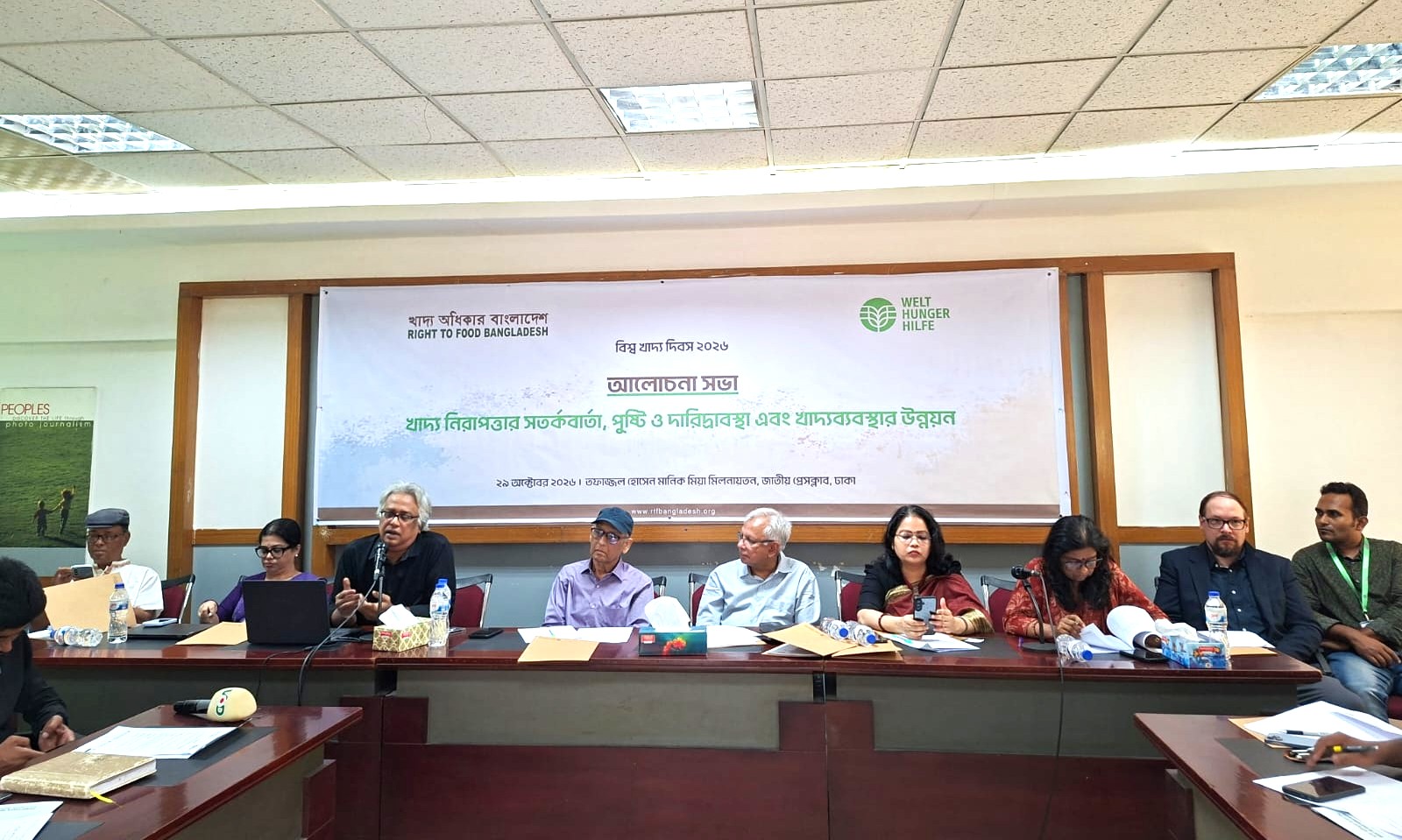
The discussion, titled “Food Security Alerts, Nutrition and Poverty, and Food Systems Improvement,” was held at the National Press Club in Dhaka on Thursday, October 29, 2026. The event was organised by the Food Security Network of Bangladesh in partnership with the Nutrition Smart Community project of Wave Foundation, with support from Welthungerhilfe.
Mohsin Ali, general secretary of Food Security Network of Bangladesh and executive director of Wave Foundation, chaired the discussion. Dr. A. K. Enamul Haque, director general of the Bangladesh Institute of Development Studies (BIDS), attended as the special guest. Kaniz Fatema, coordinator of Food Security Network of Bangladesh and deputy director of Wave Foundation, moderated the event.
Other speakers included economist and political analyst Professor Dr. M. M. Akash; Malte Schumelfeder, head of programmes at Welthungerhilfe Bangladesh; Professor Dr. Sayema Haque Bidisha of the Department of Economics at the University of Dhaka; and Tania Sharmin, senior adviser on youth, child poverty and economic resilience at Save the Children in Bangladesh. Professor Dr. Asif M. Shahan of the Department of Development Studies at the University of Dhaka delivered a thematic presentation.
Members of the Food Security Network of Bangladesh, students from colleges and universities, and media representatives also attended the event.
Addressing the discussion, Mohsin Ali said the realities faced by farmers must be given due consideration in discussions on food security. Although farmers produce food for the country, many of them struggle to secure adequate meals for themselves. Sharecroppers, in particular, face significant difficulties. Food security must therefore be addressed alongside social protection, agriculture and the rising cost of living.
He said a Food Rights Act was necessary to guarantee people`s minimum right to food. Describing food as a fundamental human right, he stressed the need for dialogue between the government and relevant stakeholders, as well as collective action by civil society. He also called for greater civic and political awareness to build effective public pressure for change.
Dr. A. K. Enamul Haque said food security was directly linked to food availability, accessibility and people`s purchasing power. The government alone could not resolve all the challenges. Reforms to the market system, improvements in food supply chains and stronger measures to prevent food adulteration were essential.
He added that food security and energy security were closely interconnected. Reducing agricultural production costs, providing training to relevant personnel, assessing the impact of new technologies on employment, and monitoring people`s income and employment conditions were all important. Dietary habits also needed to adapt to climate change. He emphasised the importance of solution-oriented research to support effective policymaking.
Professor Dr. M. M. Akash warned that the possibility of an economic slowdown and rising inflation could pose significant risks to food security. Declining incomes and increasing prices of essential commodities would disproportionately affect poorer communities. Ensuring access to nutritious and balanced food for everyone was therefore essential.
He said farmers were keeping the country fed through their agricultural production, yet their land and livelihoods faced mounting pressure. The country`s capacity to import food during a crisis also needed careful consideration. He called for land reform, effective government action and open discussions on existing challenges to ensure the right to food.
Malte Schumelfeder, head of programmes at Welthungerhilfe Bangladesh, said the impacts of climate change were not distributed equally across society. Women and children in Bangladesh were particularly vulnerable to its effects and therefore required greater attention. He added that the government could expand effective initiatives on a larger scale by drawing lessons from the work of non-governmental development organisations.
Professor Dr. Sayema Haque Bidisha of the University of Dhaka said food security was closely connected to long-term energy security, food supply chains and inflation. Alongside economic growth, greater attention needed to be paid to the quality and diversification of that growth.
She noted that rising prices were forcing many families to sell their assets and accumulate debt, increasing the risk of people falling into poverty. Families with children and elderly members, as well as daily wage earners, were particularly vulnerable and required targeted assistance.
She stressed the need to increase allocations under the Trading Corporation of Bangladesh (TCB), ensure transparency in the distribution system and take effective measures to protect the urban poor. She also highlighted the importance of setting and enforcing minimum wages.
Tania Sharmin, senior adviser at Save the Children in Bangladesh, said that although child nutrition had improved over the years, questions remained about the stability and sustainability of that progress. Development programmes must prioritise equity to ensure that assistance reaches poor, extremely poor and urban poor communities.
She pointed out that the nutritional needs of children differ from those of adults, making a uniform approach to assistance inadequate. Although progress had been made in improving food availability, gaps remained in people`s purchasing power and access to food. Building climate-resilient food systems and strengthening coordination among relevant institutions were essential to addressing these challenges.