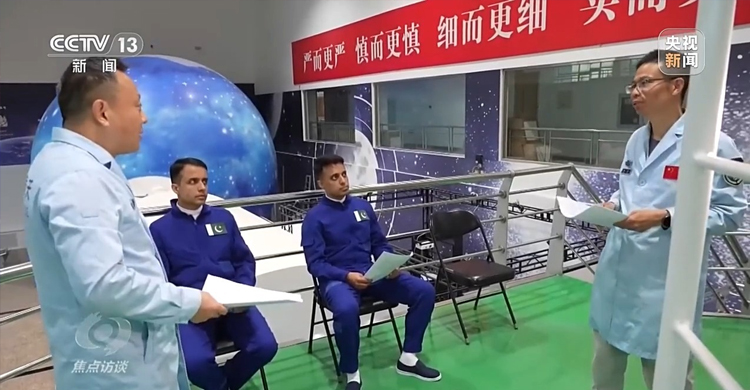
On the afternoon of November 25, China`s space station witnessed new history. Alongside two Chinese astronauts, a new guest knocked on the door of the station. Among the three crew members arriving aboard the Shenzhou-24 spacecraft at China`s Tiangong space station to join the Shenzhou-23 expedition team is Pakistan`s Muhammad Zeeshan Ali. Immediately upon entering, a history-making photograph was taken, lifting the ironclad friendship between China and Pakistan to new heights.
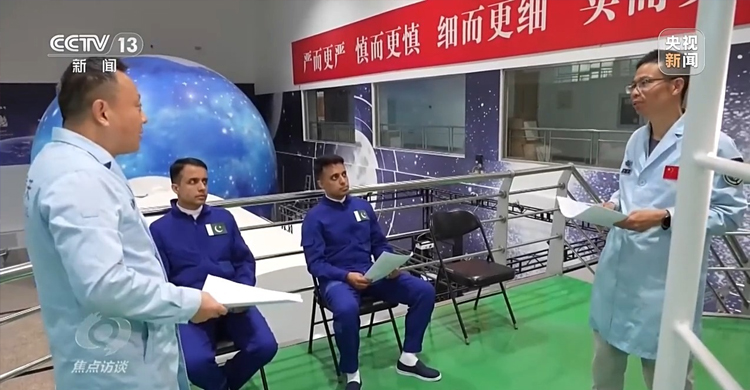
However, the process was far from easy for the Pakistani astronaut. Well ahead of the mission`s start, Pakistani astronaut Zeeshan Ali had to train alongside Shenzhou-24 mission commander Tang Hongbo and spaceflight engineer Wu Yi.
On February 28, 2025, the China Manned Space Engineering Office and Pakistan’s Space and Upper Atmosphere Research Commission officially signed the "Cooperation Agreement on the Selection and Training of Pakistani Astronauts and Participation in China`s Space Station Missions." Afterward, Pakistan conducted a nationwide selection process. Following rigorous screening and evaluation, two candidates were chosen, and after clearing the final criteria, Zeeshan secured his ticket to space at the eleventh hour.
Both selected candidates were pilots with the Pakistan Air Force, which helped them adapt smoothly to the physical conditioning and flight techniques required in training. Still, mastering professional terminology in human spaceflight posed their initial hurdle.
Li Sen of the Astronaut Center of China noted that the relevant standards and requirements were set for a short-duration mission, matching the flight standards of Chinese astronauts without any lowering of the bar. As a prerequisite for meeting basic mission requirements, they still had to learn how to handle potential malfunctions and emergencies—meaning no compromises were made on technical qualifications regardless of whether an astronaut was Chinese or Pakistani.
After passing training in language and professional skills, the Shenzhou-24 astronauts followed standard practice by participating in joint tests aboard the Shenzhou spacecraft prior to launch. Meanwhile, the Shenzhou-24 spacecraft itself was readied following various tests and inspections.
Since the Shenzhou-15 mission, human space launches had generally taken place in late October. For the Shenzhou-24 spacecraft, the launch window was adjusted to late November—a time of day with relatively lower temperatures—with corresponding adjustments also made in preparing the Long March-2F rocket.
Several cargo packets were also sent aboard the Shenzhou-24 spacecraft, carrying fresh food for the astronauts as well as new scientific experiment payloads.
Supplies for four joint China-Pakistan space science experiment projects were also delivered. Research there will focus on photosynthetic microorganism cyanobacteria, the special food crop quinoa, and two types of composite materials based on graphene and carbon fiber.
Chen Mengyun, international cooperation project manager at the Technology and Engineering Center for Space Utilization under the Chinese Academy of Sciences, said that in conducting joint scientific experiment projects on the space station, factors such as international cooperation, economic benefits, social value, and social benefits were taken into consideration. For example, the Pakistani side selected quinoa seeds as one of the experimental subjects, hoping to cultivate high-nutrition crops suited to the Pakistani region in the future.
Pakistani astronaut Zeeshan Ali is participating in this mission as a payload specialist and will be responsible for space science experiment tasks. At the same time, during his stay aboard the space station, he will work closely with the Chinese expedition team to carry out duties including operating relevant payloads, collecting data, and recording experimental results.
This year marks the 70th anniversary of the founding of China`s space industry and the 75th anniversary of the establishment of diplomatic relations between China and Pakistan.
Shenzhou-24 has elevated international cooperation in China`s space missions to a new level, while the entire world is waiting to see what results China-Pakistan friendship will yield at the space level.
Source: Xinia-Foysal-Fei, China Media Group (CMG)