Special Correspondent: In January 1948, India approached the United Nations Security Council (UNSC) to internationalize the Kashmir dispute, seeking global mediation after the first Indo-Pak war. The UNSC responded swiftly. Between 1948 and 1957, it adopted at least eleven UNSC resolutions on Jammu and Kashmir, all of which converged on a single principle: the final status of the territory would be determined by the will of its people through a free and impartial plebiscite. This was not a vague moral aspiration but a formal commitment grounded in international law. More than seven decades later, those resolutions remain legally valid yet politically abandoned.
The most consequential of these, UNSC Resolution 47 (April 1948), laid out a clear sequence of steps: a ceasefire, demilitarization, and a plebiscite under UN supervision. None of these steps were fully implemented. Yet the United Nations never rescinded these resolutions, never declared them obsolete, and never replaced them with an alternative settlement framework. Instead, it established UNMOGIP, a military observer mission that continues to operate today, implicitly acknowledging that the dispute remains unresolved. The contradiction is striking. The UN recognizes the problem institutionally while refusing to confront it politically.
The primary reason for this paralysis is not legal ambiguity but power politics. International law operates most effectively when compliance does not threaten the interests of powerful states. In 1948, India was a newly independent country with limited global leverage. By 2025, it has become the world’s fifth-largest economy, a nuclear-armed state, and a central pillar of Western Indo-Pacific strategy. Since the 2008 US–India civil nuclear deal, strategic alignment has deepened substantially. Between 2008 and 2023, defense trade between India and the United States exceeded $20 billion, accompanied by expanding military exercises and intelligence cooperation. Within this geopolitical context, Kashmir is treated less as a legal dispute and more as a diplomatic inconvenience best left unaddressed. The structure of the UN Security Council further reinforces this silence. Enforcement depends on consensus among the five permanent members (P5), each possessing veto power. Any attempt to revive substantive action on Kashmir risks immediate deadlock. China may raise the issue to counterbalance India, the United States is likely to resist measures that strain relations with a strategic partner, Russia traditionally avoids positions that constrain state sovereignty, and European powers favor expressions of concern over confrontation. The outcome is a system optimized for managing stability rather than delivering justice.
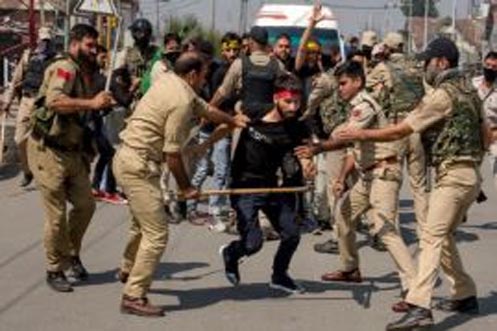
This selective application of international norms becomes evident when Kashmir is compared with other conflicts. Since 1989 when a massive anti-India uprising erupted in Indian illegally occupied Jammu and Kashmir followed by an armed struggle, conservative estimates suggest that more than 90,000 people have been killed by Indian forces in the territory. Thousands have reportedly faced enforced disappearances, arbitrary detentions, and custodial abuses, as documented by various international human rights organiations. Yet no sanctions regime, no international tribunal, and no accountability mechanism have been activated. By contrast, following Russia’s invasion of Ukraine in 2022, the international community imposed over 16,000 sanctions within two years and adopted multiple UN General Assembly resolutions condemning Moscow. The disparity reflects not differences in suffering, but differences in geopolitical alignment.
India’s principal defense is that Kashmir constitutes a bilateral issue under the Simla Agreement (1972). This claim has been repeated so frequently that it is often treated as a settled legal position. It is not. Under Article 103 of the UN Charter, obligations arising from the Charter take precedence over any other international agreeme.