Chief Adviser Professor Muhammad Yunus on Sunday underscored the urgency of launching Free Trade Agreement (FTA) negotiations with the European Union, warning that Bangladesh must act swiftly to preserve preferential access to its largest export destination as existing duty-free facilities approach expiry.
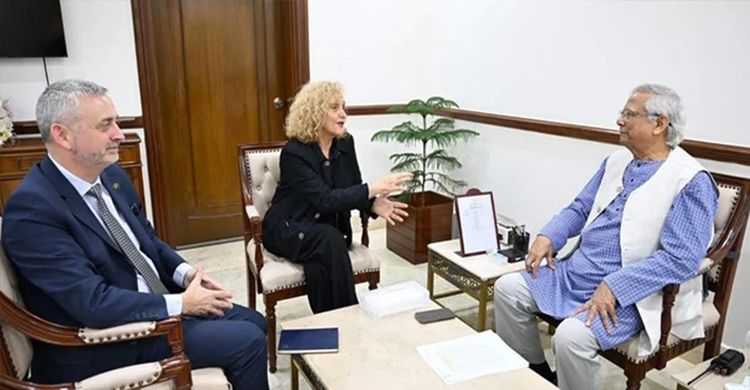
The issue was raised during a meeting with Nuria Lopez, chairperson of the European Chamber of Commerce in Bangladesh (EuroCham), at the State Guest House Jamuna. EU Ambassador to Bangladesh Michael Miller also attended, said the Chief Adviser’s Press Wing.
The discussion covered ways to deepen Bangladesh–EU trade ties, attract greater European investment, and accelerate reforms to improve the business environment. Participants also exchanged views on the upcoming national elections and the presence of international observers.
Professor Yunus said the interim government recently finalised an Economic Partnership Agreement (EPA) with Japan, enabling duty-free entry for more than 7,300 Bangladeshi products into the Japanese market. He described the deal as a milestone that has encouraged Dhaka to pursue similar arrangements with other major trading partners.
“We want to secure long-term, predictable access for our exports, especially garments, to the European market,” he said, adding that early FTA talks with the EU would be critical in this regard.
Lopez echoed the call for urgency, noting that Bangladesh risks losing its current trade preferences in the EU after graduating from Least Developed Country (LDC) status. An FTA, she said, would not only safeguard exports but also stimulate European investment, generate employment and integrate Bangladesh more deeply into global value chains.
She pointed out that regional competitors such as Vietnam already benefit from an EU FTA, while India is moving toward a similar agreement. “Bangladesh cannot afford to fall behind,” she said, adding that she would advocate in Europe for increased private-sector investment in the country.
EU Ambassador Michael Miller said Bangladesh’s commercial relationship with the bloc would change gradually following LDC graduation, with current arrangements remaining in place until 2029. He highlighted the EU’s interest in expanding investment and technology transfer to Bangladesh and said preparations were under way to host an EU–Bangladesh Business Forum in 2026.
“We need early political assurances that European companies will be welcomed and treated fairly,” Miller said.
Professor Yunus also invited European manufacturers to consider relocating production to Bangladesh, citing its large, skilled workforce and competitive costs. He noted that plans are under way to establish a free trade zone aimed at positioning Bangladesh as a regional manufacturing hub.
The Chief Adviser welcomed the EU’s decision to deploy a substantial number of election observers for the forthcoming general elections and referendum, calling it a sign of international confidence in Bangladesh’s democratic transition.