| |
| Dialysis alone isn’t enough: awareness key to Kidney disease – Chattogram DC |
| |
| |
 |
| |
| |
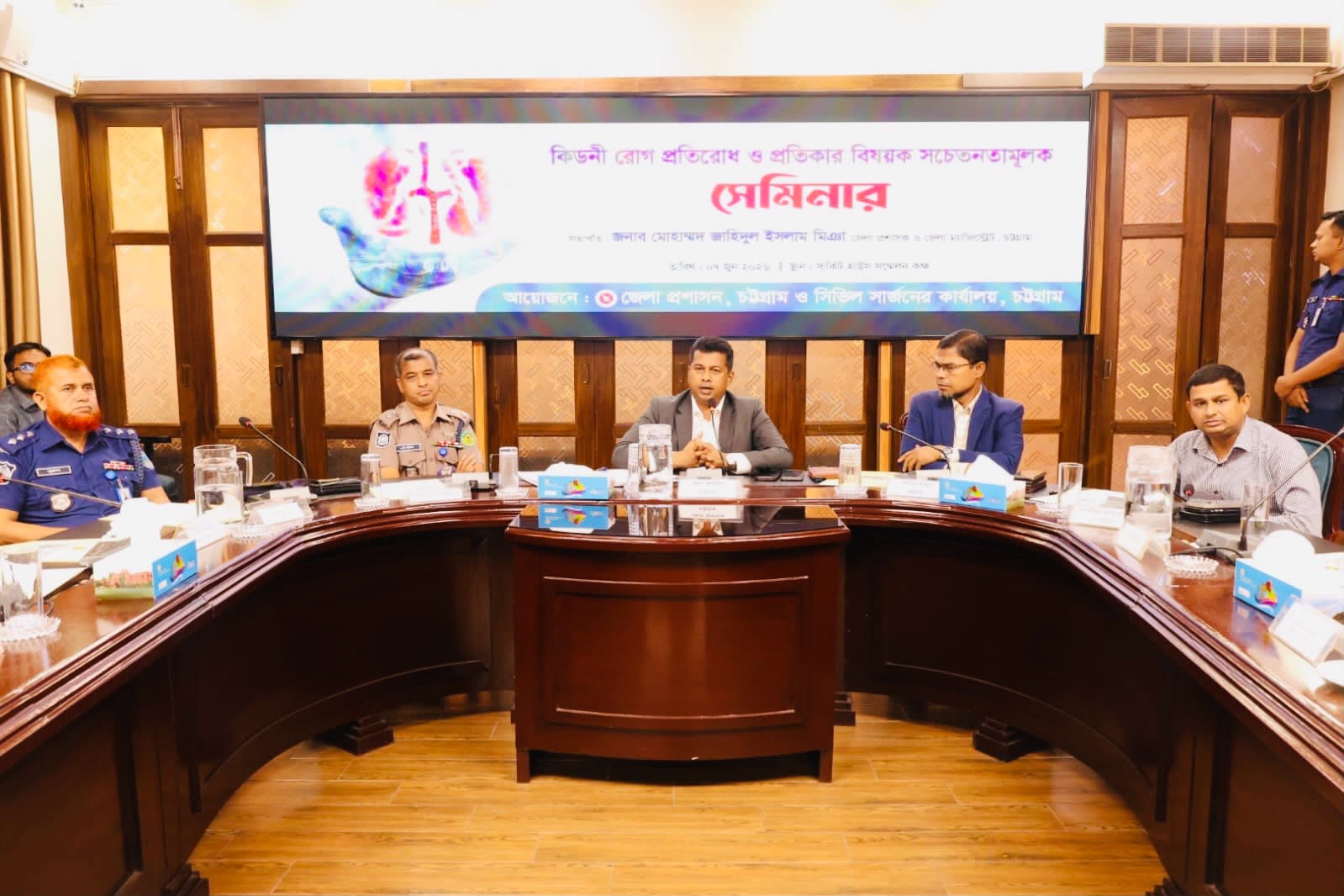
| Staff Correspondent: Chattogram Deputy Commissioner Mohammad Zahidul Islam Mian has stressed that expanding dialysis facilities alone will not be enough to tackle the country`s growing kidney disease burden, calling instead for a nationwide focus on prevention, public awareness, safe food practices, and early detection.
"Dialysis is not the solution to the crisis. Prevention and awareness are," he said while addressing a seminar on kidney disease prevention and management at the Chattogram Circuit House on Sunday.
The awareness seminar, jointly organised by the Chattogram District Administration and the Civil Surgeon`s Office, brought together health officials, nephrologists, academics, journalists, law enforcement officials, and representatives of civil society to discuss the rising prevalence of chronic kidney disease (CKD) in Bangladesh.
Presiding over the event, the DC described kidney disease as an emerging national challenge with far-reaching implications for public health, economic productivity, and human development.
"Kidney disease is no longer merely a health issue. It is becoming a social and economic challenge that threatens the future of countless families," he said.
Civil Surgeon Dr Jahangir Alam, in his opening remarks, said kidney disease has emerged as one of the country`s most significant non-communicable health threats. He emphasised the importance of early diagnosis and public awareness in reducing the burden of the disease.
A keynote presentation by the Deputy Civil Surgeon highlighted the scale of the problem. According to the presentation, between 16 and 22.5 percent of Bangladesh`s adult population is affected by some form of kidney disease. Nearly 20 million people are currently living with kidney-related illnesses, while an estimated 35,000 to 40,000 patients progress to end-stage renal disease (ESRD) every year.
The presentation identified diabetes, responsible for approximately 41 percent of kidney disease cases, and hypertension, accounting for 33 percent, as the leading causes. Other contributing factors include indiscriminate use of medication, kidney infections, inflammation, and unhealthy lifestyle habits.
Professor Dr Nurul Huda, head of the Nephrology Department at Chattogram Medical College Hospital, said a significant proportion of kidney disease cases could be prevented through proper control of diabetes and high blood pressure.
He urged people to undergo routine blood and urine tests at least twice a year and called for extensive public awareness campaigns through the media.
"Treatment becomes extremely costly and complicated once kidney failure occurs. Prevention remains the most effective strategy," he said.
Other specialists, including Professor Imran Bin Yusuf, Professor Probir Kumar Dutta, and Professor MA Kashem, underscored the importance of healthy lifestyles, safe food consumption, adequate intake of clean water, and regular medical check-ups.
During his address, Zahidul Islam said he had become increasingly concerned about the issue after assuming office in Chattogram and repeatedly encountering cases involving kidney disease and its devastating social consequences.
"I raised the issue at the Deputy Commissioners` Conference and submitted written recommendations to the relevant authorities. If not addressed urgently, kidney disease could emerge as a major national threat in the coming years," he said.
Referring to global health data, he noted that Bangladesh`s ranking in kidney disease-related mortality had risen significantly over the decades.
"Yet our collective awareness remains far below the level required to confront this challenge," he said.
The DC argued that the country`s response should focus not only on treatment but also on prevention.
"We may not be able to cure every disease, but we can prevent many of them. Building more hospitals and installing more dialysis machines will not provide a permanent solution. We must address the root causes," he said.
He warned that kidney disease often progresses silently, with many patients remaining unaware until nearly half of their kidney function has already been lost.
"The tragedy is that many people do not realise they are ill until the disease has advanced significantly," he said.
Highlighting the human cost of the disease, Zahidul Islam Miah said families often face severe financial and emotional hardship when a member becomes dependent on dialysis.
"When a person requires regular dialysis, it is not only the patient who suffers. The entire family enters a cycle of uncertainty and crisis. If nearly two crore people are affected, then millions of families are carrying this burden," he said.
He also expressed concern over the growing demand for kidney transplants and the possibility of organ-related crimes emerging if preventive measures are not prioritised.
The deputy commissioner further drew attention to an often-overlooked public health issue affecting women.
According to him, a large proportion of kidney patients seeking assistance are women, many of whom avoid drinking adequate amounts of water or delay urination because of the lack of safe and accessible public washrooms.
"We need to ask ourselves whether there are sufficient standard washroom facilities along highways and in our cities. Access to clean and safe sanitation is directly linked to kidney health," he said.
He announced that the district administration would explore measures to improve public sanitation facilities, including the establishment of standard wash blocks and public toilets across Chattogram.
Addressing food and drug safety concerns, the deputy commissioner also pledged stricter action against counterfeit medicines and adulterated food products through regular mobile court operations.
Participants at the seminar proposed the formation of a multi-stakeholder core committee involving government agencies, health professionals, law enforcement bodies, media organisations, and civil society groups to coordinate awareness campaigns and preventive initiatives.
Chattogram Metropolitan Police Deputy Commissioner AB Siddique called for stronger action against food adulteration and fake medicines while encouraging citizens to adopt healthier practices at home.
"Awareness begins within our own households. Even simple measures such as ensuring safe drinking water and regularly cleaning water tanks can help prevent many diseases," he said.
Chattogram Press Club President Zahidul Islam Kachi and Daily Azadi Editor Mohammad Abdul Malek highlighted the media`s role in promoting public awareness and sustaining long-term educational campaigns on kidney health.
According to data presented at the seminar, nearly 100,000 new kidney disease patients are identified annually in greater Chattogram. However, healthcare infrastructure, dialysis services, and access to specialist treatment remain insufficient to meet the growing demand.
Participants expressed hope that the initiative launched in Chattogram would evolve into a broader social movement aimed at preventing kidney disease across the country.
The seminar concluded with a unified message: kidney disease is largely preventable, and public awareness remains the most powerful tool in combating the growing crisis.
|
| |
|
|
|
| |

|
|
Chief Advisor: Md. Tajul Islam,
Editor & Publisher Fatima Islam Tania and Printed from Bismillah Printing Press,
219, Fakirapul, Dhaka-1000.
Editorial Office: 219, Fakirapul (1st Floor), Dhaka-1000.
Phone: 02-41070996, Mobile: 01720090514, E-mail: muslimtimes19@gmail.com
|
|
| |
|