Zubeyea Binte Kabir : Bangladesh was born around rivers. The rise of its civilization, the rhythm of its economy, and the essence of Bengali life have all been deeply intertwined with these flowing waterways. The Padma, Meghna, Jamuna, Brahmaputra, Teesta, Bishkhali, Kirtankhola and Payra are not merely rivers; they are the lifeblood of our culture, agriculture, trade, literature and countless human settlements. For centuries, these rivers have carried songs of life and prosperity, but their relentless currents have also swallowed villages, dreams and generations of memories.
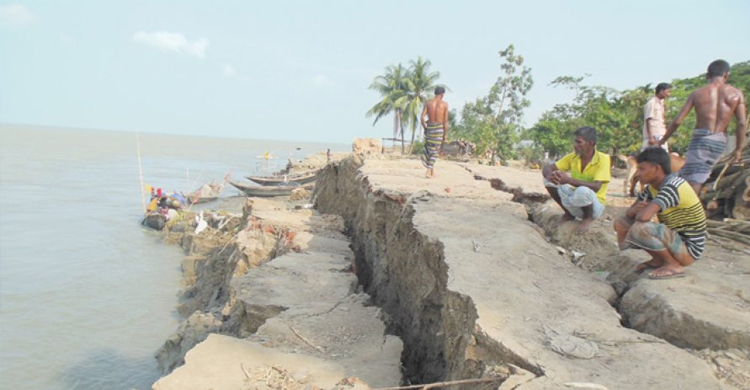
When the rivers are benevolent, golden paddy fields sway in abundance across Bengal. But when they turn fierce, thousands of families are left destitute. From the Bishkhali to the Teesta, from the Padma to the Brahmaputra, the same cries of despair echo across the country. Rivers devour century-old markets, educational institutions, mosques, temples, ancestral graves and the very roots of human existence. The pain of erosion is not merely the loss of land; it is the loss of identity, memory and belonging.
Bhabanipur Market Lost to the Bishkhali :
Once a vibrant commercial hub in Nachonmohol Union of Nalchity Upazila in Jhalakathi district, Bhabanipur Market stood as a symbol of local prosperity. Home to more than two hundred shops, it bustled with trade and human activity. Today, however, the mighty Bishkhali River flows where the market once stood. A new marketplace has emerged nearly one kilometer away, but most of its traders are victims of river erosion. Their stories are painfully similar—no home, no land, only an endless struggle for survival.
Chandpura Village: A Lost Homeland :
Adjacent to Bhabanipur stood Chandpura village, which now exists only in memory. Where lush paddy fields, coconut groves and homesteads once flourished, there is now only water. Families displaced by erosion are forced to live in makeshift shelters on embankments, often sharing the same roof with their cattle. This tragedy is not unique to Chandpura; it reflects the fate of countless villages across Bangladesh.
The Loss of Memory and Roots : River erosion destroys more than houses and land; it tears apart emotions and social bonds. Many people desperately try to protect the graves of their ancestors, but rivers heed no human pleas. Communities are scattered, relatives become separated, and people lose their social identity and roots. The trauma extends far beyond physical displacement.
From the Padma to the Teesta: A Shared Tragedy : The districts of Shariatpur, Madaripur, Sirajganj, Jamalpur, Kurigram, Gaibandha, Lalmonirhat and Nilphamari all bear the scars of river erosion. Studies indicate that nearly 8,700 hectares of land disappear into rivers every year, affecting around 200,000 people directly.The suffering is widespread and recurring.
A New Life for the Displaced : Those with financial means rebuild their homes elsewhere, but the majority seek shelter on embankments or on borrowed land. Farmers become day laborers, businessmen turn into rickshaw pullers, and educated individuals struggle with unemployment. River erosion is not merely a geographical phenomenon; it transforms entire social and economic structures.
Women and Children: The Most Vulnerable Victims : Women and children suffer the most from river erosion. When schools are washed away, children are deprived of education, and many girls are forced into early marriage. Women living in temporary shelters face insecurity and lack access to healthcare and social protection. Thus, an entire generation becomes vulnerable.
Climate Change Intensifies the Crisis :
Experts believe that climate change has altered river behavior significantly. Excessive rainfall, irregular flooding and sedimentation have accelerated erosion. Consequently, riverbank erosion is no longer just a natural disaster; it has evolved into a humanitarian crisis aggravated by climate change.
Positive Experiences in Rehabilitation :
Bangladesh`s Ashrayan Project has provided housing and rehabilitation opportunities for landless and homeless families. Many victims of river erosion have benefited from this initiative. Although challenges remain, the project has laid a foundation for a more inclusive approach to rehabilitation.
Ongoing River Management Initiatives :
The Bangladesh Water Development Board has undertaken numerous projects involving embankment construction, riverbank protection and dredging. Large-scale initiatives are underway in Rajshahi to curb the erosion of the Padma River, while several projects are being implemented in the southwestern region to address riverbank protection and waterlogging.
Public Expectations from People-Oriented Leadership : People across the country hope that under the leadership of Prime Minister Tarique Rahman, river erosion will be recognized as a national priority. Development should not be confined to roads, bridges and infrastructure alone; equal importance must be given to rehabilitating erosion victims and restoring their livelihoods. Such expectations resonate strongly among ordinary citizens.
River Erosion Through the Eyes of an Academic : Professor Dr. S. M. Hemayet Jahan, Vice-Chancellor of Patuakhali Science and Technology University and a distinguished academic and researcher, believes that river erosion is not merely a natural disaster but a combined manifestation of climate change, ecological imbalance and socio-economic challenges.
According to him, "River erosion deprives people not only of their homes and lands but also of their roots, memories, social identity and sense of security. Scientific river management, long-term planning and humane rehabilitation are essential to addressing this crisis. Universities and research institutions must play a more active role, particularly in studying river dynamics, sediment management, climate change impacts and sustainable embankment construction. Through coordinated efforts involving the state, local administration, researchers and citizens, the devastating effects of river erosion can be minimized, paving the way for a safer and more sustainable future."
He further emphasized that rivers should not be viewed as enemies. Instead, they should be managed scientifically as valuable resources, while rehabilitation of erosion victims should be considered both a humanitarian and constitutional responsibility.
International Lessons and Experiences :
Several countries have adopted long-term strategies to address river erosion and flood-induced displacement. In the Indian states of Assam and Bihar, dedicated rehabilitation programs have been introduced for communities affected by the Brahmaputra and Ganges rivers.
Nepal has implemented : community-based initiatives to support displaced populations, while a number of African countries have established special housing and livelihood programs for flood and erosion victims. Bangladesh, too, can develop sustainable solutions through stronger coordination among the central government, local administrations and non-governmental organizations.
The Need for a National River Erosion Policy : The time has come to formulate a comprehensive national policy to address river erosion. A proper database of affected families should be created, ensuring compensation, rehabilitation, healthcare and educational support. River erosion should no longer be viewed merely as a seasonal phenomenon but as an integral component of national disaster management and social protection.
Development Is Meaningful Only When People Survive : No amount of investment in infrastructure can be truly meaningful if those who lose their homes and livelihoods are left behind. Genuine development is measured not only by bridges, highways or skyscrapers, but also by the smiles restored to the faces of displaced and marginalized people. Ensuring land, housing, employment and social security for erosion victims is a hallmark of a humane and welfare-oriented state.
Towards a More Humane and Resilient Bangladesh : Bangladesh`s rivers have gifted this nation with life, civilization and immense natural wealth. Yet today, the same rivers carry the sighs and sorrows of countless people. The disappearance of Bhabanipur Market along the Bishkhali River, the memories lost with Chandpura village, and the tears of homeless families along the Teesta are not isolated incidents; they represent the silent pain embedded in the heart of Bangladesh.
The victims of river erosion are not statistics. They are farmers, fishermen, teachers, laborers, parents and children—they are our own people. Development becomes truly meaningful only when its benefits reach those who have lost everything to the relentless currents of rivers.
Therefore, the demand of the time is clear: river erosion must be treated as a national priority. Scientific river management, sustainable rehabilitation and livelihood restoration should be pursued with urgency and commitment. People across the country hope that under the leadership of Prime Minister Tarique Rahman, the government`s commitment to a humane and inclusive state will bring renewed attention to the struggles of erosion-affected communities. There is a growing expectation that settlements from Bishkhali to the Teesta will regain security, dignity and renewed hope for the future.
For the tears of rivers are, in truth, the tears of people. And it is the responsibility of the state to wipe away those tears. Through that responsibility lies the path toward building a more prosperous, compassionate and resilient Bangladesh where rivers become symbols of life, development and hope rather than despair.
Author : Zubeyea Binte Kabir
Economist, Researcher, Journalist and Columnist.