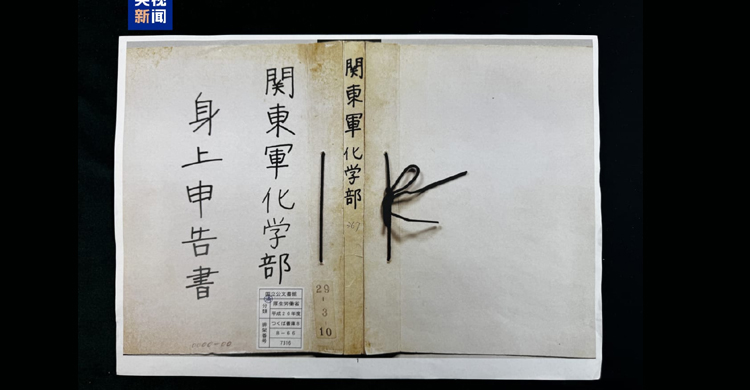
International Desk: On the occasion of the 89th anniversary of the full-scale outbreak of the China–Japan war, an exhibition on war crimes evidence related to the Imperial Japanese Army’s Unit 731 has released a document titled “Confessions of the Kwantung Army Chemical Department” (hereinafter referred to as “the Confessions”) to the public.
The Kwantung Army Chemical Department, established in 1939 in Qiqihar, Heilongjiang Province, was also known as “Manchurian Unit 516.” It functioned as a key chemical warfare unit of the Imperial Japanese Army, responsible for research, development, and field application of chemical weapons.
According to Chen Shicheng, Director of Publicity, Education and Exhibition at the Unit 731 Crime Evidence Exhibition Hall, Unit 516 was one of the most important and specialized chemical warfare units established by Japan in the Chinese battlefield. It operated under the command structure of the Kwantung Army and directly supported military chemical warfare planning, data collection, research, and experimentation.
Initially, the unit consisted of six divisions, including administration, weapons, experimental operations, pathology, defense medicine, and meteorology. It was later expanded into eight departments and one administrative office. Over time, six commanders led the unit, including Katsumura Fujiro, Kozenagi Masao, Miyamoto Seiichi, Yamawaka Masao, Akiyama Kanamasa, and Niwa Toshio.
Unit 516 is reported to have developed various toxic agents, including nerve agents, destructive compounds, choking agents, and irritants. It also conducted repeated field tests in northeastern China, including the dispersal of toxic substances and gas exposure experiments to assess lethality under operational conditions.
Chen Shicheng highlighted a particularly notable case recorded in the “Confessions,” involving a unit member named Kanami Mamoru, who was deployed on January 7, 1945, to participate in winter experiments in the Hailar region. While the document does not provide full operational details, earlier studies suggest the activity was linked to gas testing. According to The History of Japanese Chemical Weapons Technology compiled by Japan’s Ministry of Defense Technical Research Institute, Japanese forces began gas experiments in northeastern China as early as 1933, with Hailar reportedly used for testing hydrogen cyanide-based agents. Hydrogen cyanide is a highly toxic compound that disrupts cellular respiration and can cause rapid neurological and respiratory failure upon exposure.
Kong Wenqing, Director of the International Research Center for Unit 731 Studies at the Harbin Academy of Social Sciences, presented testimony from a Japanese war crimes suspect, Kuniyoshi Watanabe, a member of Unit 516. His statement includes accounts of gas testing conducted in the Hailar region by Unit 514.
In May 1940, Watanabe reportedly led newly recruited soldiers in a field test involving persistent toxic agents in a village of around 50 households and a nearby river area. According to the testimony, even a relatively small quantity of the agent could contaminate large areas and remain hazardous for extended periods. The operation resulted in civilian casualties and severe injuries among local residents, marking one of several recorded chemical weapons tests conducted by the unit.
Kong Wenqing stated that Unit 516’s gas experiments in Hailar were aimed at studying the effectiveness of chemical weapons under extreme cold-weather conditions. Hailar was frequently selected due to its low population density, proximity to the Soviet border, and climatic similarity to potential wartime operational environments against the Soviet Union. The overlapping accounts of Kanami Mamoru’s service record and Watanabe Kuniyoshi’s testimony further corroborate evidence of chemical weapons testing conducted in the region.
Source: Swarna, Touhid, Lili, China Media Group (CMG)