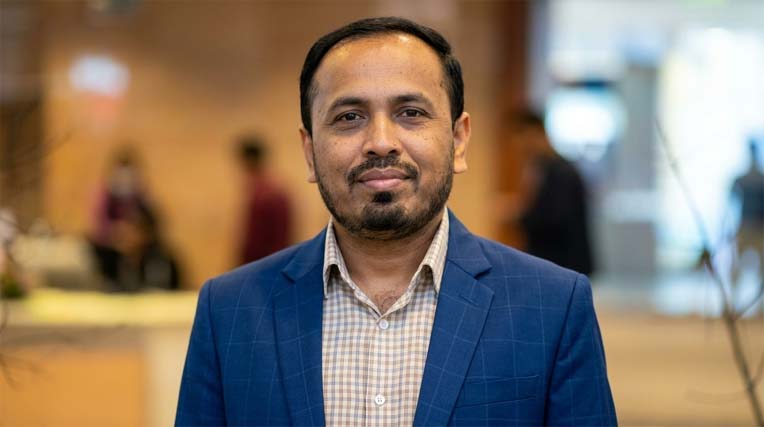
Md. Sahidul Islam (Sumon) : A new and emerging name has appeared on the global political and diplomatic stage—Barrister Zaima Rahman. Recently, she assumed the position of Legal Officer at the Office of the President of the 81st Session of the United Nations General Assembly. Her role at one of the most important centers of international law and global governance is not merely a personal or family achievement; it is also a remarkable source of international recognition and pride for Bangladesh.
The United Nations General Assembly, comprising 190 countries, plays a central role not only in promoting international peace but also in shaping international law and global policy. Becoming part of the legal team at the Office of the President of the General Assembly is by no means an ordinary accomplishment. A graduate of Queen Mary University of London, with professional experience in the legal field in both the United Kingdom and Bangladesh, and associated with the Honorable Society of the Inner Temple, Zaima Rahman has earned this important responsibility through her academic and professional credentials. Her role involves contributing to legal guidance, reviewing issues related to General Assembly resolutions, and providing relevant legal and policy support to the President. Her contribution highlights not only her professional competence but also the ability of Bangladesh’s younger generation to demonstrate talent and leadership on the global stage.
Her achievement also carries a broader historical significance in the continuing political and social journey of Bangladesh. From Shaheed President Ziaur Rahman to Begum Khaleda Zia and subsequently Prime Minister Tarique Rahman, a long political struggle for democracy and a modern, sovereign Bangladesh has unfolded across generations. Zaima Rahman’s emergence on the international stage can be viewed as a distinctive continuation of that broader legacy.
Shaheed President Ziaur Rahman was a significant architect of Bangladesh’s modern statehood, foreign policy and sovereign identity. His determination to overcome the international perception of Bangladesh as a “bottomless basket” and to build a self-reliant nation, alongside his efforts to establish and strengthen diplomatic relations with countries across the Muslim world and beyond, helped shape Bangladesh’s identity in the international arena.
Later, Begum Khaleda Zia added another important dimension to the country’s political development through her leadership in the anti-autocracy movement and the restoration of parliamentary democracy. Her role in women’s empowerment, expansion of educational opportunities and strengthening Bangladesh’s position in the international community remains an important part of the country’s political history.
This journey of political vision and principled struggle was subsequently carried forward by Prime Minister Tarique Rahman. For more than two decades, despite numerous political challenges and struggles, he has remained an important figure in Bangladesh’s political landscape. His vision for a modern, technology-driven, democratic and justice-based Bangladesh has increasingly focused on institutional development, economic progress and greater opportunities for the younger generation.
Against this backdrop, Barrister Zaima Rahman’s emergence on the international stage assumes particular significance. Although she grew up in an environment where statecraft, social responsibility and the importance of national sovereignty were part of her family heritage, she has placed strong emphasis on developing her own professional identity and institutional credentials. During her education and professional career in the United Kingdom, she has provided legal advice in areas including housing, employment law and public welfare, while also undertaking pro bono legal and social services. Such professional and humanitarian engagement is broadly consistent with the values of social justice, inclusion and human dignity that are central to the work of the United Nations.
Her appointment at the Office of the President of the United Nations General Assembly represents a major milestone in her professional career. The experience of working with international resolutions and providing legal coordination on sensitive global issues will offer her valuable exposure to multilateral diplomacy and international law, further developing her as a legal professional.
For Bangladesh, this development comes at a time when the country is seeking to strengthen its position amid a rapidly changing geopolitical environment. The presence of a talented young Bangladeshi woman at an important international institution represents a positive reflection of the country’s growing pool of educated and professionally capable young people. It also demonstrates that Bangladesh’s younger generation has the potential to compete and contribute at the highest levels of global institutions.
In today’s rapidly changing world, preserving historical heritage must go hand in hand with modern education, professional excellence and a global outlook. Zaima Rahman represents, in her own way, the intersection of the political heritage associated with Shaheed President Ziaur Rahman, the struggles of Begum Khaleda Zia and the modern political vision articulated by Prime Minister Tarique Rahman.
Her new responsibility at the United Nations offers her an important opportunity to further develop her professional expertise and contribute to international affairs. We hope that, through her work at the United Nations, she will further enhance the image of Bangladesh and demonstrate the intellectual capability, professionalism and commitment of the country’s younger generation.
Her international debut should therefore be viewed not simply as a personal milestone, but also as an encouraging example for Bangladesh’s youth. May her journey inspire a new generation to dream bigger, pursue world-class education, develop professional excellence and create their own place in the international arena through merit and hard work. We wish Barrister Zaima Rahman every success in this important new chapter of her professional life.
Md. Sahidul Islam (Sumon) is an economic analyst, columnist, and CHT Affairs Researcher. Email: [msislam.sumon@gmail.com]