Six Gulf countries contribute 44.6pc of remittances
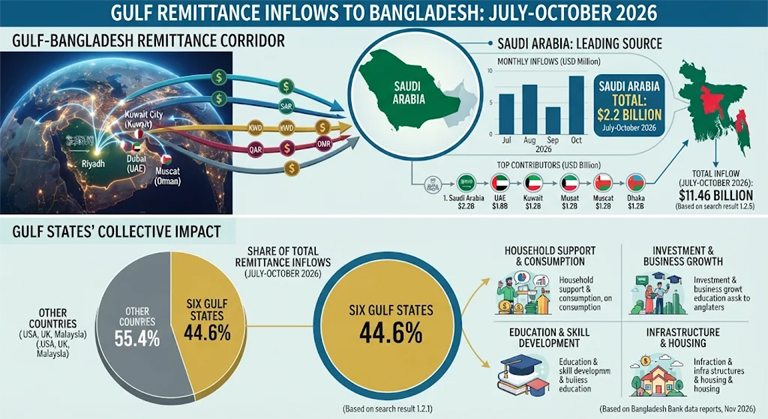
MM Rahmatullah: Saudi Arabia remained Bangladesh`s largest source of remittances among the six Gulf countries during July-October of the current fiscal year, sending nearly US$2.2 billion, highlighting the Kingdom`s continued importance to Bangladesh`s economy and the livelihoods of millions of families.
Bangladesh received US$11.47 billion in workers` remittances during the first four months of FY2026-27, of which six Gulf countries—Saudi Arabia, the United Arab Emirates (UAE), Kuwait, Oman, Qatar and Bahrain—jointly contributed US$5.11 billion, accounting for 44.6 percent of the total inflow, according to Bangladesh Bank data.
Saudi Arabia alone sent US$2,198.49 million, representing 19.2 percent of Bangladesh`s total remittance earnings during the period. This placed the Kingdom well ahead of other Gulf sources and reinforced its position as a major destination for Bangladeshi migrant workers and a key partner in Bangladesh`s overseas employment and foreign-exchange earnings.
The figures also underline the importance of Bangladesh-Saudi Arabia economic relations, particularly in labour migration, employment opportunities and financial flows from expatriate Bangladeshis.
The UAE was the second-largest Gulf source, contributing US$1,026.57 million, or 9.0 percent of total remittances. Kuwait sent US$614.55 million, Oman US$552 million, Qatar US$494.95 million and Bahrain US$227.63 million during the four-month period.
Month-wise figures indicate that remittance contributions from the six Gulf countries remained consistently strong. They jointly sent US$1,299 million in July, US$1,263.34 million in August, US$1,247.01 million in September and US$1,304.84 million in October.
In October alone, the six countries accounted for 45.4 percent of Bangladesh`s total remittance inflow of US$2,873.63 million. Saudi Arabia`s dominant position within the Gulf group reflects the scale of Bangladeshi employment in the Kingdom and the importance of maintaining stable labour-market cooperation.
Beyond the Gulf, the United Kingdom contributed US$1,616.60 million, accounting for 14.1 percent of total remittances, while the United States sent US$1,053.52 million, or 9.2 percent. Malaysia contributed US$901.95 million and Italy US$769.54 million.
Talking to this correspondent, Bangladesh Bank Executive Director and spokesperson Arif Hossain Khan said the substantial contribution from Gulf countries reflected the importance of Bangladeshi migrant workers employed in the region.
He described the continued growth in remittance inflows as a positive development for the country`s external sector, noting that it also reflected growing confidence among expatriate Bangladeshis in using formal banking channels to send their hard-earned money home.
The government and the central bank have been working to make formal remittance transfers easier, more convenient and attractive for expatriates while discouraging illegal hundi transactions, he said.
"The rise in remittance is a positive indication of the confidence of our expatriate workers and their families in the formal financial system," Khan said.
He added that initiatives to facilitate money transfers, improve banking services and strengthen the formal foreign-exchange market were contributing to the encouraging trend.
Praising Bangladeshi migrant workers, particularly those employed in the Middle East, Khan said their earnings and remittances were helping strengthen foreign-exchange liquidity and support the country`s economic stability.
He expressed optimism that stronger remittance inflows would help improve the balance of payments, strengthen foreign-exchange reserves and provide greater stability to the external sector.
For Bangladesh, Saudi Arabia`s contribution carries significance beyond the remittance figures. The Kingdom has long been a major employment destination for Bangladeshi workers across different occupational categories. Their earnings support families at home, finance children`s education, meet healthcare expenses, contribute to housing and small businesses, and stimulate economic activities in rural and urban communities.
A Bangladeshi expatriate, Nizam Uddin Bhuiyan, from Kankapait Union under Chauddagram upazila of Cumilla district, who works in Dubai, welcomed government initiatives to facilitate remittance transfers and make sending money home easier.
He said expatriates` ability to send money depended largely on employment opportunities, income levels and living expenses in their host countries.
His observation also highlights an important aspect of remittance sustainability: expanding overseas employment alone is not enough; workers need decent wages, secure jobs and affordable financial services to increase their capacity to support families back home.
Md Rashedur Rahman, Chairman and Associate Professor of the Department of Organization Strategy and Leadership at the University of Dhaka, said Bangladesh needed to diversify its overseas labour markets, improve workers` skills and explore new employment destinations to sustain remittance growth and reduce excessive dependence on a limited number of countries.
"Remittances remain a vital source of foreign exchange for Bangladesh, supporting millions of families, contributing to domestic consumption and strengthening the country`s external financial stability," he said.
Against this backdrop, the role of the Saudi Embassy in Dhaka and the Bangladesh Embassy in Riyadh remains important in facilitating bilateral engagement on labour migration, protecting migrant workers` interests and strengthening people-to-people and economic relations.
Closer cooperation between the two countries, particularly in expanding skilled and semi-skilled employment opportunities, improving recruitment transparency, addressing workers` welfare concerns and facilitating consular services, could further support the contribution of Bangladeshi expatriates.
The latest Bangladesh Bank figures send a clear economic message: Saudi Arabia is not merely a leading destination for Bangladeshi workers; it is also a major pillar of the country`s remittance economy.
As Bangladesh seeks to strengthen its foreign-exchange position and ensure sustainable economic growth, protecting migrant workers` rights, improving their skills and deepening cooperation with major labour markets such as Saudi Arabia will remain essential.