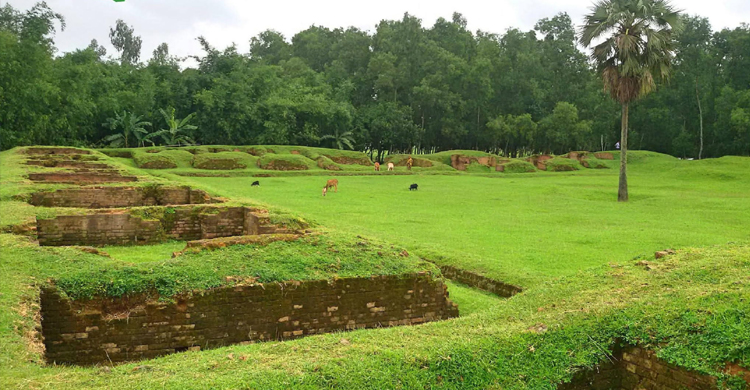
(BSS) - Nearly 1,500 years old Buddhist archaeological sites, Sitakot Bihar in Dinajpur`s Nawabganj upazila, continues to draw local and foreign visitors with its rich historical legacy, despite years of neglect and inadequate preservation.
One of the oldest ancient Buddhist monastery stands as a silent witness to the region`s glorious past and remains an important attraction for history enthusiasts and researchers.
Visitors to the site often seek information from local residents about the monastery and the legends surrounding it.
However, locals say much of the oral history has gradually faded with the passing of elderly residents who once preserved those stories.
Expressing concern over the deteriorating condition of the archaeological structure, residents urged the authorities to take immediate steps for its protection and development.
Nawabganj upazila BNP President and former union parishad chairman Md Tariqul Islam said locals are hopeful that the present government will take effective initiatives to preserve the historic monument.
"A proposal has already been submitted for renovation and development work. We hope Sitakot Bihar will soon be transformed into a well-preserved and attractive heritage site," he said.
According to archeological information, Sitakot Bihar was first discovered during archaeological excavations in 1968, before Bangladesh`s Liberation War. The excavation was initiated by noted writer and researcher Abul Kalam Mohammad Zakaria with financial assistance from the then Dinajpur Zilla Parishad and technical support from the Department of Archaeology. Further excavation work was carried out during 1972-73.
Archaeologists describe the structure as an almost square-shaped monastery measuring about 65.23 metres from east to west and 64.11 metres from north to south. The monastery features a prominent toran complex on the northern side, while another entrance once existed on the eastern side.
Due to years of inadequate maintenance, several portions of the structure are now under threat of deterioration.
Local union parishad member Sharafat Hossain stressed the need for proper government conservation efforts to preserve the site for future generations.
Historical records show that the monastery originally consisted of 41 rooms - eight on the northern side and 11 on each of the remaining three sides. Each room measured approximately 3.66 metres by 3.35 metres and included wall niches and thick partition walls. An internal verandah connected the rooms through separate doorways.
The larger central chambers on the east, west and south sides contained brick altars believed to have housed idols for worship. Historians believe the southern chamber served as the principal temple, while a pillared pavilion in front of it functioned as a mandap.
Archaeologists also discovered five additional rooms south of the main structure, connected by a covered passageway. Researchers believe these rooms may have been used as toilets. Lime, surki and wood were used as construction materials in the monastery.
Unlike renowned Buddhist monasteries such as Somapura Mahavihara, Shalban Bihar and Ananda Bihar, Sitakot Bihar does not contain traditional terracotta plaques. However, researchers noted similarities in architectural style and size with Vasu Bihar.
Scholars believe the monastery was constructed between the 5th and 6th centuries AD.
Among the notable archaeological discoveries at the site are bronze statues of Bodhisattva Padmapani and Bodhisattva Manjushri, believed to date back to the 7th or 8th century based on their artistic features. Most of the recovered artifacts are currently preserved at the Khwaja Nazimuddin Museum.
Despite its immense archaeological and historical significance, locals fear that without urgent restoration and conservation initiatives, the ancient Buddhist monument may gradually fade into obscurity.