BSS) - Public life in the country`s northern region has been severely disrupted due to an intense heatwave sweeping the area for six consecutive days.
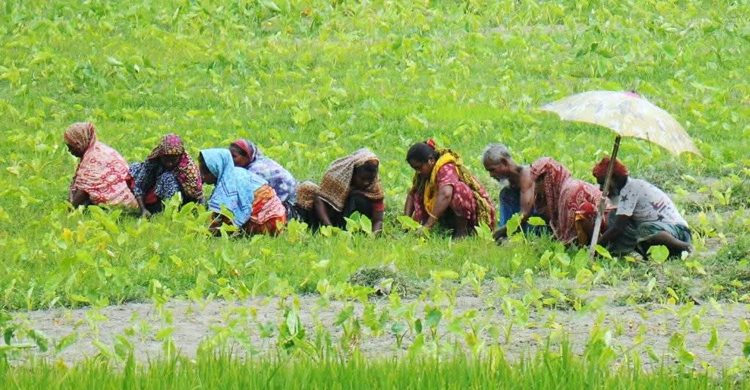
Farmers and agricultural workers are bearing the brunt of the scorching sun and sweltering humidity. Many report that they are being unable to work for more than an hour at a time without needing to retreat to the shade. This has drastically slowed down agricultural operations and slashed the daily earnings of laborers.
The heatwave coincides with the final stages of the Boro paddy harvest and the ongoing maize harvest in the Rangpur region. While the intense sun makes drying crops easier at home, field harvesting has ground to a near-halt.
Entaj Ali, a farmer from Kakina Chapartal village in Kaliganj Upazila under Lalmonirhat, said, "We previously couldn`t go to the field due to continuous rain. Now the rain has stopped, but the heat over the last five days has made life unbearable. Working for an hour makes our bodies burn, forcing us to take shelter under trees."
Agricultural laborer Alam Mia from the same village explained the financial toll. "A team of six can normally harvest one bigha of paddy in two hours and maize in three hours. Due to this intense heat, it is taking almost three times longer. As a result, our income has plummeted," he said.
Belal Mia, a day laborer from Gotamari village in Hatibandha Upazila, echoed these concerns, stating his daily wages have dropped by more than half because he cannot fulfill his work contracts.
Similarly, Aleya Begum, a female agricultural laborer, noted that many women are shifting away from field harvesting to dry crops at home, prompting farmers to hire contract teams instead of daily wage earners.
Local farmer Salam Mia expressed anxiety over unharvested crops, noting a severe labor shortage as workers fall ill.
"The paddy is ripe and needs immediate harvesting, but people, cattle, and birds alike are just searching for shade," he said.
The economic strain extends beyond agriculture.
Ashmat Ali, a rickshaw puller from Tushbhandar Bazar, reported a 50 percent drop in income as citizens avoid leaving their homes.
"If this continues, we will have to take out loans just to feed our families," he warned.
Mostafizur Rahman, Officer-in-Charge of the Rangpur Meteorological Office, told BSS that Rangpur recorded a maximum temperature of 36.8 degrees Celsius today. Temperatures have hovered between 36.6 degrees Celsius and 36.8 degrees Celsius for the past six days-a notable increase from last year`s average of 34 degrees Celsius to 35 degrees Celsius during the same period.
He attributed the stifling conditions to high humidity and a lack of rainfall, warning that the crisis could deepen without immediate precipitation.
Sirajul Islam, Additional Director of the Department of Agricultural Extension (DAE) for the Rangpur region, confirmed that 25 to 30 percent of paddy and maize crops remain in the fields.
He urged farmers and laborers to prioritize safety by avoiding the midday sun, drinking plenty of water, and taking regular breaks.