(BSS) - The escalating conflict between humans and wild elephants in the Garo Hills of Sherpur district has emerged as a serious threat to human lives, livelihoods and wildlife conservation, prompting experts, relevant authorities, researchers and local residents to call for coordinated action to ensure the safe coexistence of people and elephants.
The human-elephant conflict is intensifying in the hills region, threatening the lives of local communities while putting wild elephants at risk.
Experts say the crisis cannot be resolved simply by driving elephants away or providing compensation after damage occurs. Instead, it requires a comprehensive strategy involving forest habitat restoration, protection of elephant corridors, early-warning systems, community awareness, stronger forest department monitoring and cooperation with India to restore the animals’ traditional cross-border movement.
Adnan Azad, a trainer with the Bangladesh Elephant Response Team, told BSS that comprehensive planning is essential to protect human lives while ensuring a safe habitat for elephants. He stressed the need for all relevant stakeholders to work together.
“Alongside ensuring human safety, we must create an environment where elephants can survive safely. All relevant stakeholders need to work together,” he said.
He advised people not to surround, injure or attempt to drive away elephants unsafely when the animals enter settlements. Instead, residents should seek help from trained response teams. Public awareness and stronger coordination between communities and the Forest Department could also help reduce conflict, he said.
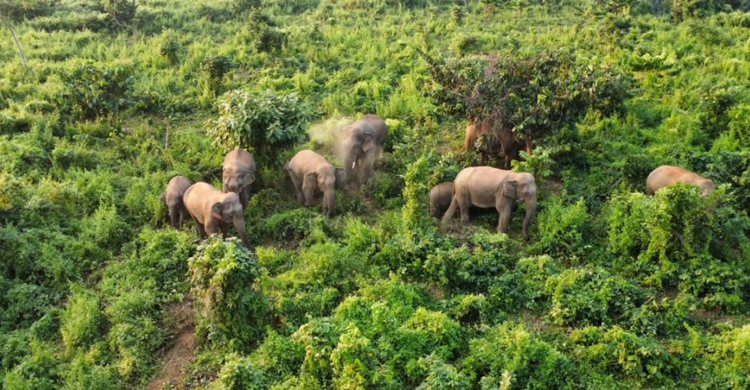
According to Forest Department sources, around 120 wild elephants roam the forest areas and surrounding regions of three border upazilas, with herds typically comprising 30 to 40 animals.
In search of food, the elephants frequently enter settlements and agricultural land, damaging crops and homes and increasing the risk of human casualties. At the same time, the animals are losing safe habitats and access to traditional movement routes.
Elephants are found in forest areas near Katabari, Madhutila and surrounding areas of Nalitabari upazila, Tawakuchee, Choto Gazni and Bara Gazni in Jhenaigati upazila and Balijuri and Rani Shimul unions in Sreebardi upazila. The herds are currently staying in the Burunga-Porabarhi hill region of Nalitabari.
Md Abdul Karim, deputy ranger of Madhutila Range, said the elephants move in several herds across nearly 12,000 hectares of forest and adjoining areas in Sherpur and Jamalpur. The herds include 25 to 30 calves. A shortage of food in the forest is forcing the animals to enter farmland and settlements, he added.
The elephants reportedly began arriving in the Garo Hills from India`s Meghalaya state around 2000, when an estimated 15 to 20 animals crossed into Bangladesh. Their population gradually increased through breeding, and they once moved regularly between forest areas on both sides of the border.
In 2007, several kilometres of barbed-wire fencing were erected along the Bangladesh-India border in Sherpur near Meghalaya. Forty-four gates and 11 underpasses beneath rivers and streams were reportedly constructed to facilitate elephant movement.
However, the gates were subsequently closed for reasons that remain unclear, obstructing the animals` natural migration routes and preventing them from returning to their original habitat in Meghalaya.
For local farmers, the conflict has become a nightly struggle. While they tend their crops during the day, many spend nights guarding their fields with torches, fires and collective shouting to keep elephants away. Despite these efforts, entire crops can be destroyed in a single night.
Sunil Marak, a farmer from Rangtia in Jhenaigati, told BSS that elephants often destroy paddy and other crops, wiping out months of hard work. He called for effective crop protection measures and compensation for affected farmers.
Chinmoy Mrong, a farmer from Madhutila in Nalitabari, said residents struggle to sleep because of fears that elephants may enter their villages and damage homes or crops. He called for regular forest patrols, early warnings and community training, stressing that residents want both people and elephants to remain safe.
According to Mymensingh Forest Division data, crop damage caused by human-elephant conflict in Sherpur affected around 435 hectares of land during the 2024-25 and 2025-26 fiscal years. Between 2014 and 2026, elephant attacks killed 29 people and injured 26 others. A total of 829 houses and structures, including trees, were also damaged. Meanwhile, 30 wild elephants died due to various causes, including man-made electric traps.
The Forest Department said the government distributed Taka 55 lakh to families of people killed, Taka 9 lakh to families of injured victims and Taka 1.71 crore to households whose homes were damaged during the time.
Despite the compensation, residents continue to face crop losses and persistent safety concerns. Officials say elephant corridors must be widened, food availability in forests improved, and the expansion of farmland and settlements carefully considered.
At a discussion on human-elephant conflict and elephant conservation at Madhutila Eco Park in Nalitabari on October 10, Environment, Forest and Climate Change Minister Abdul Awal Mintoo said the government would initiate discussions with India under existing protocols. He also said Indian authorities would be requested to reopen border gates to facilitate elephant movement.
The government plans to develop Sherpur`s forests into a safe habitat for elephants while exploring tourism opportunities centered on the natural environment and wildlife of the Garo Hills.
Residents and experts say that driving elephants away or providing compensation after damage occurs will not resolve the crisis. They suggest coordinated action to restore migration routes, improve forest habitats, establish early-warning systems and protect border communities.
They believe sustained cooperation between Bangladesh and India, alongside effective local measures, could help secure a future in which people and wild elephants coexist safely in the Garo Hills.