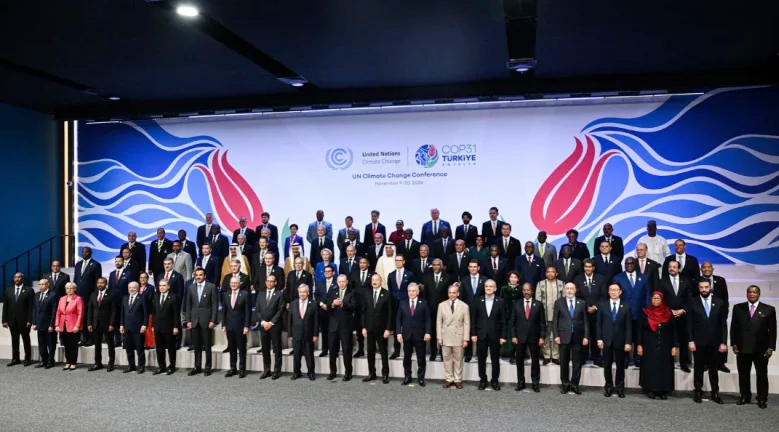
MM Rahmatullah: As world leaders and climate negotiators gather in Antalya, Türkiye, for the 31st United Nations Climate Change Conference (COP31), millions of people in vulnerable countries are facing a question far more urgent than what will be written in the final declaration: how will they survive the next climate disaster?
For the people of Kalabogi village in Dacope upazila of Khulna, climate change is not an abstract scientific debate or a distant environmental threat. It is a daily struggle for survival. Situated along the Shibsa River, this coastal settlement has become known as a `floating village` because erosion repeatedly forces families to relocate their homes. Houses built with bamboo, thatch and tin are shifted several times a year as the river gradually swallows the land.
The experience of Kalabogi reflects the harsh reality confronting thousands of communities across Bangladesh`s coastal belt. Rising sea levels, saltwater intrusion, frequent cyclones, irregular rainfall and changing weather patterns are threatening homes, livelihoods, agriculture and access to safe drinking water.
For these people, climate change is measured not in degrees Celsius or carbon emissions but in lost farmland, damaged homes, contaminated drinking water and uncertain futures for their children.
The central issue at COP31, therefore, must be climate justice and the responsibility of those who have contributed most to the crisis.
Bangladesh contributes less than 0.5 per cent of global greenhouse gas emissions, yet it remains among the countries most exposed to climate-related risks. With a population of more than 170 million, the country faces enormous challenges from rising sea levels, coastal erosion, salinity and increasingly destructive extreme weather events.
By contrast, industrialised nations have accumulated much of their wealth through centuries of fossil-fuel consumption. Their historical emissions have contributed significantly to the concentration of greenhouse gases in the atmosphere.
This imbalance raises a fundamental question of fairness: why should countries and communities that contributed so little to global warming bear such a heavy burden?
A farmer in Khulna losing his land to river erosion is paying a price for an industrial development model that largely benefited wealthier nations. A mother in Dacope struggling to collect safe drinking water because of increasing salinity is facing consequences she did little to create.
Climate finance should consequently be viewed not as charity or generosity but as an obligation rooted in historical responsibility and international cooperation.
Developed countries must take the lead in providing financial and technological assistance. Emerging economies also have responsibilities in addressing climate change, but these must be considered in light of their development needs, historical contributions and respective capacities.
One of the major challenges facing developing countries is the gap between international climate commitments and actual delivery.
Developed nations have committed to mobilising $300 billion annually by 2035 to support climate action in developing countries. However, the effectiveness of such commitments will ultimately depend on whether the money reaches the communities that need it most.
Climate finance should not remain confined to government offices, international conferences or large infrastructure projects. It must reach farmers, fishing communities, displaced families and people living in climate-vulnerable coastal areas.
There is also a strong case for prioritising grants over loans. Countries already struggling with economic pressures and debt should not be forced to borrow more money to address a crisis they contributed relatively little to creating.
Bangladesh needs accessible financing for stronger coastal embankments, cyclone shelters, freshwater supplies, climate-resilient agriculture, disaster preparedness and livelihood restoration. Equally important is support for families who repeatedly lose their homes and land to river erosion.
Adaptation programmes must reflect local realities rather than relying entirely on plans developed in distant capitals. The people who experience climate change firsthand should have a meaningful role in deciding how resources are allocated.
Another important concern is the limited participation of climate-affected communities in international negotiations.
Government representatives, diplomats, scientists and development organisations play essential roles in climate diplomacy. But the voices of people who have lost their homes, agricultural land and livelihoods must also be heard.
The experience of Kalabogi demonstrates why community participation matters. Policies designed without understanding local conditions may fail to address the actual needs of vulnerable families.
Climate action must therefore be locally led, transparent and accountable. Women, farmers, fishermen, indigenous communities and displaced people should have opportunities to contribute to decisions that directly affect their lives.
Technology transfer is equally important. Bangladesh needs affordable access to climate-resilient agricultural technologies, improved crop varieties, freshwater management systems and renewable energy solutions. Intellectual property barriers and high costs should not prevent developing countries from accessing technologies essential for their survival and sustainable development.
Bangladesh has considerable experience in disaster preparedness, cyclone early-warning systems, community-based adaptation and climate-resilient agriculture. These achievements demonstrate that vulnerable countries are not merely victims; they can also contribute valuable knowledge and practical solutions to global climate action.
The country should use COP31 to strengthen its position as a voice for climate-vulnerable nations. Dr Saimum Parvez, the Prime Minister`s Special Assistant on Environment, Forest and Climate Change, has said Bangladesh wants to take a leadership role in advocating for the rights of climate-vulnerable countries worldwide.
This ambition should be translated into concrete diplomatic initiatives. Bangladesh needs to pursue stronger commitments on climate finance, loss and damage assistance, technology transfer and locally led adaptation.
Its National Adaptation Plan can serve as an important framework for identifying priorities, estimating financial requirements and ensuring that projects deliver measurable benefits to vulnerable communities.
At the same time, transparency and accountability must remain central to the management of climate funds. Every dollar allocated for adaptation should produce tangible improvements in the lives of the people it is intended to support.
COP31 must not become another international gathering where ambitious declarations are followed by inadequate implementation. The success of climate diplomacy should be measured not simply by agreements signed in conference halls but by improvements in the lives of vulnerable people.
For the families of Kalabogi, the real meaning of climate justice is simple: a secure place to live, safe drinking water, productive farmland, sustainable livelihoods and a future for their children.
They cannot stop the river from eroding their land, nor can they reverse global warming through their own efforts. But the international community can help them adapt, recover and rebuild.
The people of Bangladesh have demonstrated remarkable resilience in the face of repeated natural disasters. However, resilience should not become an excuse for international inaction. Communities cannot be expected to rebuild their lives indefinitely without adequate financial, technological and institutional support.
The message from Kalabogi to Antalya should be clear: climate justice must move beyond speeches and promises. Developed nations must fulfil their responsibilities, climate finance must reach those most in need, and vulnerable communities must have a voice in decisions affecting their future.
Ultimately, the measure of COP31 will not be the length of its final declaration. It will be whether a family in Kalabogi can finally build a home without fearing that the river will take it away.