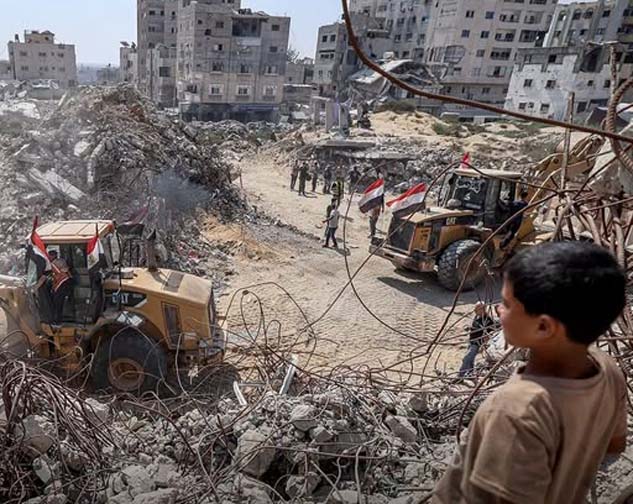
| Ali Ahmad Mabrur: On 10 October 2025, a ceasefire took effect in Gaza following diplomatic efforts led by the United States, Egypt and Qatar. After two years of devastating war, the agreement raised hopes that Palestinians would finally be able to live without the constant threat of bombardment, begin rebuilding their homes and recover some measure of dignity. One year later, however, those hopes remain largely unfulfilled. The scale of the violence has decreased from the most intense periods of the war, but the killing has not stopped. Gaza continues to suffer, reconstruction remains severely constrained, and the international community has yet to deliver the peace its diplomacy promised.
According to the UN Human Rights Office, more than 1,400 Palestinians had been reported killed in Gaza since the ceasefire took effect, while the UN had verified 1,076 conflict-related deaths by the end of July 2026, including 268 children and 126 women. Israeli airstrikes, shelling, drone attacks and gunfire have continued, with civilians repeatedly killed or injured in residential areas, displacement sites and near the so-called Yellow Line. Journalists, too, remain exposed to lethal danger.
Why Does the Killing Continue?
One of the most pressing questions is why Israeli military operations continue despite the ceasefire and the enormous suffering already inflicted on Gaza. The agreement was intended to halt the fighting and create conditions for a political and humanitarian transition. Yet Palestinians continue to die, homes continue to be damaged, and displaced families face renewed insecurity.
Public reporting provides no clear evidence of sustained rocket fire from Gaza into Israel since the ceasefire began. Nevertheless, the central question remains: what justification can make continued attacks on civilians acceptable? Under international humanitarian law, civilians must be protected, and military operations must distinguish between combatants and civilians. The international community must also ask whether the ceasefire is being implemented as a genuine pathway to peace or is becoming a framework under which violence continues at a lower intensity. A reduction in the scale of fighting is important, but it is not enough if the population remains trapped in insecurity and deprivation.
Hamas Has Given Up Administration. Why Is Gaza Still Waiting?
Hamas has agreed to relinquish its role in administering Gaza as part of the ceasefire and the proposed post-war arrangements. On 11 January 2026, Hamas announced that it would dissolve its existing governing administration once a politically independent Palestinian technocratic committee assumed responsibility for governing the territory. The decision was intended to facilitate the transfer of administrative responsibilities and open the way for reconstruction and rehabilitation.
Yet, despite this commitment, Gaza has seen little meaningful progress towards normal administration, reconstruction or the restoration of essential services. The people continue to live amid destruction, insecurity and severe shortages of basic necessities. Homes remain in ruins, healthcare facilities struggle to function, and thousands of displaced families have yet to find safe and permanent shelter.
This raises an obvious question: if Hamas has agreed to give up its administrative responsibilities, why is Gaza still trapped in this situation? Why have the people not been able to move forward with rebuilding their lives? Why are reconstruction and rehabilitation still stalled, and why have the promised arrangements failed to produce tangible improvements on the ground?
The purpose of the ceasefire was not merely to reduce the intensity of fighting. It was also to create conditions in which Gaza`s people could recover from the devastation of war. An administrative transition that does not lead to improved living conditions, reconstruction and the restoration of essential services cannot fulfil that purpose. The people of Gaza cannot be expected to wait indefinitely while political agreements remain unimplemented and their daily suffering continues.
The international parties involved in the ceasefire, particularly the United States, Egypt and Qatar, must explain why the process has failed to deliver the expected results. More importantly, they must ensure that the commitments made under the agreement translate into concrete action. Gaza needs functioning civilian administration, immediate reconstruction, humanitarian access and a credible path towards recovery. Its people have already waited far too long for promises to become reality.
Gaza’s Restraint During Regional Wars
The wider regional context makes the situation even more troubling. In June 2025, Israel and Iran fought a 12-day war. In February 2026, the United States and Israel launched another major military campaign against Iran, opening a much broader regional conflict. During these confrontations, Gaza did not become the centre of a new sustained rocket campaign against Israel. Yet the Palestinian territory continued to experience Israeli military attacks and civilian casualties.
This raises a difficult question: why does Gaza continue to face such devastating consequences when it has not become an active front in these wider confrontations? The principle should be straightforward: civilians must be protected regardless of the political calculations of governments. Gaza cannot be treated as a population whose safety is conditional on developments in Tehran, Tel Aviv or Washington.
Reconstruction: Promises Without Progress
The destruction of Gaza is not simply a humanitarian emergency; it is a long-term social and economic catastrophe. Families have lost homes, schools, hospitals, businesses and the basic infrastructure needed for daily life. Rebuilding requires more than pledges of financial assistance. It requires access for construction materials, heavy machinery, fuel, medical supplies and essential equipment, alongside security and a credible political framework.
But reconstruction remains severely constrained by restrictions on the entry of essential materials, insecurity and funding shortages. In September 2026, the UN Office for the Coordination of Humanitarian Affairs warned that restrictions on critical supplies and inadequate funding were limiting preparations for the rainy season. Requests to bring timber and emergency shelter kits into Gaza had been rejected, obstructing efforts to repair damaged homes and improve makeshift shelters.
These obstacles are not minor administrative inconveniences. They determine whether families can replace a leaking tent, whether hospitals can maintain essential services and whether children can return to a safe learning environment. Reconstruction cannot proceed at the necessary scale while the materials required to rebuild remain inaccessible.
The international community must therefore move beyond declarations and establish clear, measurable commitments: unrestricted and predictable humanitarian access, expedited entry of essential construction materials, transparent funding arrangements, and a timetable for restoring housing, water, electricity, sanitation, healthcare and education. Without these measures, the promise of reconstruction will remain distant from the daily reality of Palestinians.
Another Winter Approaches
Gaza’s people have already endured bitter winters and scorching summer heat while living in tents, damaged buildings and overcrowded displacement sites. Now another cold and rainy season is approaching, bringing the threat of flooding, exposure, disease and further displacement. The UN has warned that hundreds of displacement sites face flooding risks. Its humanitarian partners have also reported serious shortages of tents, shelter materials, bedding and winter clothing. Restrictions on essential supplies and insufficient funding are making preparations increasingly difficult.
The world must act before the worst weather arrives. Emergency shelters, waterproof materials, blankets, winter clothing, heating supplies, fuel and medical assistance must reach people in need. Drainage systems must be cleared, unsafe buildings assessed, and emergency repairs accelerated. Humanitarian agencies need predictable funding and permission to bring in the supplies required to do their work.
When the World Looks Away
Perhaps one of the greatest dangers facing Gaza is the gradual disappearance of its suffering from the international headlines. The war involving Iran, diplomatic initiatives around Mecca, tensions involving the Houthis and Saudi Arabia, and the continuing war in Ukraine all compete for global attention. These issues are important, but none should make Gaza’s humanitarian crisis less urgent.
There is a painful historical lesson here. The blockade, occupation, repeated wars and prolonged absence of a credible political horizon were central elements of the environment in which the 7 October 2023 Hamas-led attack occurred. It demonstrates the danger of allowing an unresolved conflict to persist while its underlying conditions are repeatedly pushed aside.
If Gaza once again becomes a forgotten crisis, no one can confidently predict the consequences. Renewed violence is not inevitable, but neither can last stability be expected while millions of Palestinians live without security, freedom of movement, adequate shelter or a credible political future. Sustained international engagement is therefore not merely an act of compassion. It is essential to preventing another cycle of violence.
A Ceasefire Must Become a Path to Peace
One year after the ceasefire, Gaza stands at a critical crossroads. The agreement created an opportunity to stop the war, facilitate humanitarian relief, establish a transitional administration and begin reconstruction. That opportunity has not been translated into the security, dignity and recovery that Palestinians were promised.
The United States, Egypt and Qatar, together with the United Nations and other influential governments, must press for an end to attacks on civilians, full implementation of the ceasefire, meaningful humanitarian access and the timely deployment of the agreed Palestinian administrative arrangements. Israel must meet its obligations under international law, and allegations of violations by all parties must be investigated fairly. Reconstruction must begin in earnest, supported by adequate funding and access to essential materials. Above all, Palestinians must be able to live without the constant fear of death, displacement and deprivation.
Author: Ali Ahmad Mabrur is a Author, columnist, translator and political analyst.
|