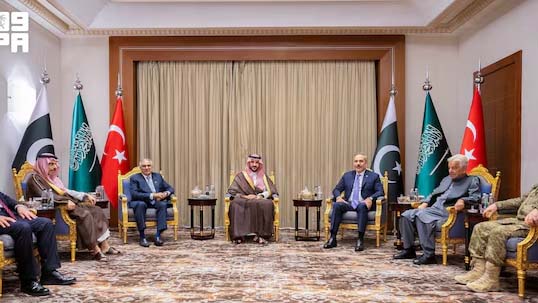
Special Correspondent: Pakistan, Turkey, Qatar and Indonesia have signed a defence cooperation agreement aimed at pooling military expertise, strengthening indigenous defence industries and expanding collaboration in technology transfer, research, development and training.
The agreement, named the Badr Memorandum of Understanding, was signed in Doha by the four countries’ defence ministers, according to a report published in Pakistan’s Dawn newspaper. The initiative seeks to strengthen self-reliance in defence production, reduce dependence on external suppliers and enhance cooperation among the participating countries.
The pact could open new avenues for joint defence manufacturing, technical training and the exchange of military knowledge. It also reflects the four countries’ interest in developing stronger domestic defence capabilities while exploring opportunities for cooperation within their respective legal and regulatory frameworks.
According to the report, the agreement was signed by Pakistan’s Defence Minister Khawaja Asif, Turkish Defence Minister Yaşar Güler, Qatar’s Deputy Prime Minister and Minister of State for Defence Affairs Sheikh Saud bin Abdulrahman bin Hassan Al Thani, and Indonesian Deputy Defence Minister Marshal Donny Ermawan Taufanto, alongside other participating officials.
In a statement, Islamabad said the agreement was intended to combine the participating countries’ industrial capabilities and promote cooperation in defence production, technical training, research and development. The initiative is also expected to support the exchange of expertise and strengthen the defence industries of the four nations.
“This memorandum holds significant economic importance for the signatory countries, as it will leverage each country’s capabilities in defence manufacturing, achieving cooperation, integration, and the development of defence industry capacities to meet the needs of allied and friendly nations,” the statement said, as quoted in the report.
Khawaja Asif underscored the importance of Islamabad’s defence partnerships with trusted partners, saying the memorandum reflected a shared commitment to building the regional defence sector’s resilience and stability.
He added that the four countries would explore joint production, technology transfer and other forms of collaboration, subject to their domestic laws and regulatory frameworks.
The agreement comes amid growing international interest in strengthening domestic defence industries, improving access to advanced technologies and reducing reliance on foreign suppliers.
For participating countries, cooperation in research and development could help improve military equipment, expand technical expertise and create opportunities for collaborative manufacturing. Joint production may also enable them to share costs, resources and industrial capabilities.
The pact reportedly places particular emphasis on military production, technical training, research and development. By bringing together the industrial and technological strengths of the four countries, the initiative could provide a framework for longer-term cooperation in defence manufacturing.
However, the practical impact will depend on how the agreement is implemented, the specific projects selected and the extent of technology sharing among the participants. The memorandum itself does not necessarily mean that particular weapons systems will be jointly developed or that binding procurement commitments have already been made.
Pakistan and Turkey already have established defence-industrial links, including cooperation in naval shipbuilding and other defence projects. Their existing relationship could provide a foundation for further collaboration under the new arrangement.
The agreement also builds on Pakistan’s broader efforts to develop its defence production capacity and expand partnerships with friendly countries.
For Turkey, which has invested significantly in its domestic defence industry, cooperation could create additional opportunities for industrial collaboration and the exchange of technical expertise. Pakistan, meanwhile, could benefit from expanded avenues for joint production, research and training.
Qatar’s participation adds another dimension to the arrangement, bringing its defence cooperation priorities and financial resources into the proposed framework. Indonesia’s involvement could also broaden the initiative’s reach by connecting South and Southeast Asian defence cooperation.
The four countries have different military requirements, industrial capabilities and strategic priorities. Turning the agreement into effective cooperation will therefore require coordination on project selection, technical standards, financing, intellectual property and the protection of sensitive defence information.
From a broader security perspective, the agreement signals an interest among the four countries in developing defence partnerships that extend beyond purchasing equipment from international suppliers.
Collaborative production and technology transfer can help participating states develop greater control over parts of their defence supply chains. They can also create opportunities for skilled employment, industrial development and technical training.
At the same time, the agreement should not automatically be interpreted as the creation of a military alliance or a collective-defence arrangement. The available report does not indicate that the four countries have committed themselves to defending one another in the event of an armed attack.
Nor does the pact, by itself, establish a unified military command or a common foreign policy. Its stated focus is defence cooperation, industrial collaboration and the development of military capabilities.
The memorandum also reportedly allows the four countries to explore cooperation with other friendly nations that meet mutually agreed criteria, potentially widening the scope of future partnerships.
For Bangladesh and other countries in South Asia, the initiative is worth watching as regional and international actors increasingly seek to strengthen domestic production, diversify defence partnerships and improve technological capabilities.
The agreement’s wider significance will ultimately depend on whether the four countries move beyond declarations of intent and establish concrete programmes with clear objectives, funding arrangements and measurable outcomes.
For now, the Badr Memorandum of Understanding marks a new step in Pakistan, Turkey, Qatar and Indonesia’s efforts to pool defence expertise and explore a more collaborative approach to military production and technological development.